
Novo Nordisk has long been a core holding for quality-focused institutional investors, having dominated the global insulin market for more than a century. However, in recent years, the company’s evolution from a diabetes specialist to a leader in weight loss therapies has fundamentally changed its valuation profile and growth trajectory.
This shift was driven by mimicking the action of the hormone glucagon-like peptide-1 (GLP-1). Originally developed to regulate blood glucose levels in patients with Type 2 diabetes without the dangerous hypoglycaemic crashes associated with traditional insulin therapies, these drugs revealed a powerful secondary effect: significant weight loss.
GLP-1 is a gut hormone that stimulates insulin secretion when nutrients are consumed. Importantly, its receptors are found not only in the pancreas, but also in the stomach and the brain. In the stomach, GLP-1 slows gastric emptying, prolonging the sensation of fullness. In the brain, it targets the hypothalamus, the brain’s appetite regulation centre, to signal satiety earlier. This dual mechanism positioned Novo Nordisk as a first mover in pharmacological treatments targeting the global obesity epidemic.
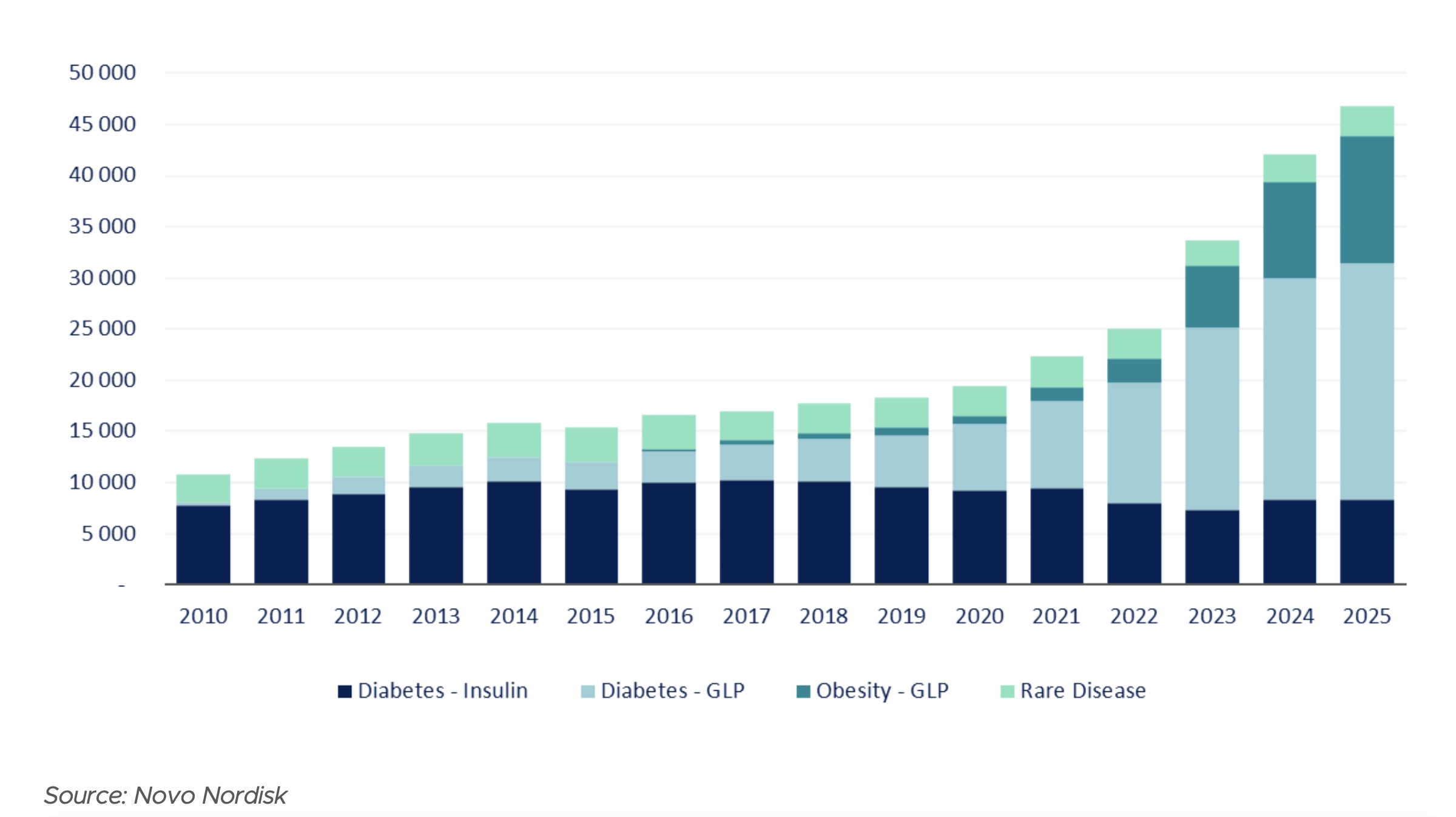
Novo Nordisk’s key innovation was semaglutide, a synthetic drug designed to mimic and amplify the effects of GLP-1 in the body on a more sustained basis. Marketed as Ozempic in 2018 for diabetes and later Wegovy for obesity, semaglutide became one of the fastest-growing pharmaceutical products in history. The chart below shows the exceptional growth in revenue contribution from the GLP-1 therapies.
Chart 1: Novo Nordisk revenue contribution by segment (USDm)
Novo Nordisk before the GLP-1 boom
Prior to the “Ozempic era,” Novo Nordisk epitomised the “quality” factor in many quantitative investment frameworks. Our analysis of the company’s performance over the decade preceding the launch (2008–2018) showed that the company delivered:
- 9% compound annual growth rate (CAGR) in sales.
- 15% compound annual growth in earnings.
- Average return on invested capital (ROIC) of 42%, with gross and operating margins of 84% and 42%, respectively, by 2018.
These results reflected a highly efficient operating model supported by strong intellectual property and manufacturing capabilities, while disciplined capital allocation meant the company returned DKK 257bn to shareholders via dividends and buybacks against cumulative earnings of DKK 275bn.
This combination of strong growth, exceptional returns on capital and shareholder-friendly capital allocation made Novo Nordisk a textbook example of a high-quality compounder.
Valuation reset creates opportunity
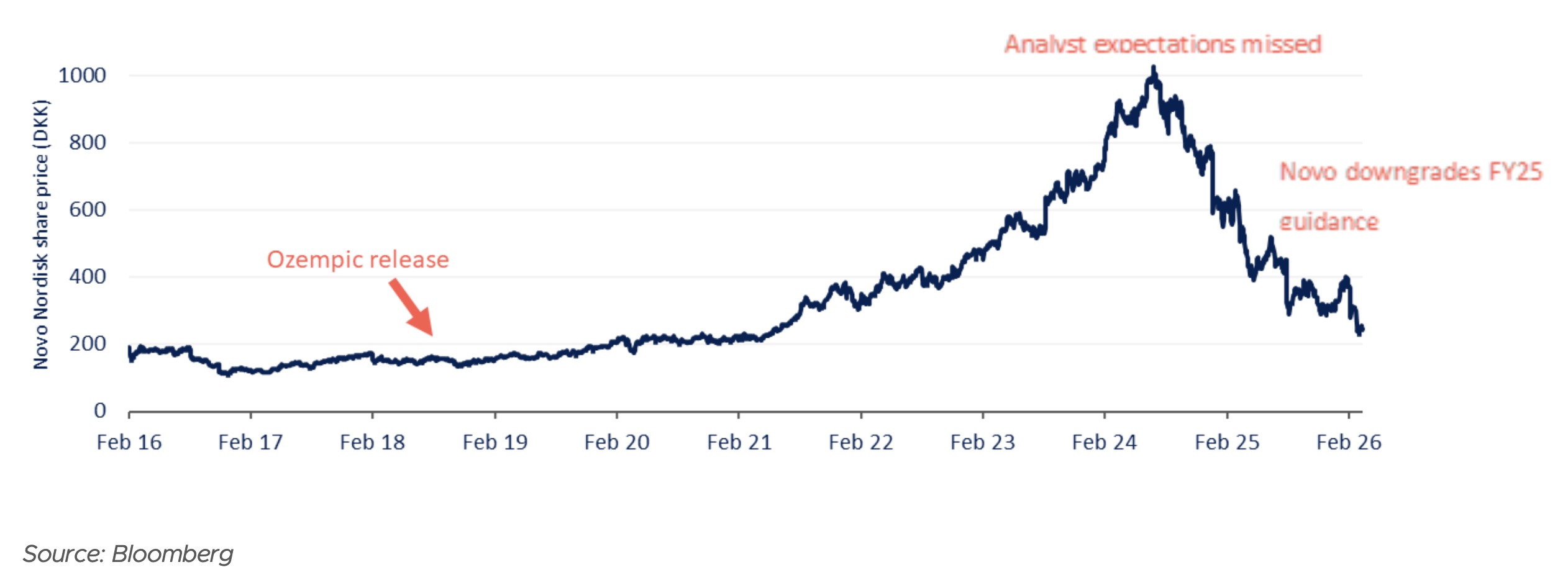
Following a six-year period during which the share price compounded at approximately 40% per year, valuations reached extreme levels by 2024. Market sentiment soured sharply following missed analyst expectations and subsequent downward revisions to guidance, with the stock declining by approximately 60% from its peak by April 2025. This correction compressed the one-year forward Price-to-Earnings (P/E) multiple from approximately 35x to a compelling 15x. At that point, the investment case appeared interesting. A high-quality business addressing a vast global obesity market, operating in a two-player market with Eli Lilly and benefiting from what appeared to be a strong moat around manufacturing the active pharmaceutical ingredient.
Chart 2: Novo Nordisk valuation reset
Given a compelling valuation, Truffle invested in Novo Nordisk during April to June 2025. At the time our fundamental bottom-up valuation approach led us to identify several factors that supported the investment case as outlined below:
Massive addressable market:
At the time of our investment, the GLP-1 anti-obesity market generated roughly USD 30 billion in annual revenue, with forecasts suggesting it could expand to USD 120-150 billion within a decade. Globally, 768 million individuals are classified as obese, yet only 2% a receive pharmacological treatment. This implied a long runway for volume growth that could offset potential price erosion. Furthermore, Novo Nordisk’s patent estate appeared secure until 2031-2032 in major jurisdictions, while the anticipated rollout of oral semaglutide could significantly broaden patient access.
Limited competition:
In early 2025, the market structure resembled a duopoly between Novo Nordisk and Eli Lilly. While Lilly was gaining market share, our analysis suggested this was primarily driven by Novo’s supply chain constraints rather than a fundamental rejection of its products. With the overall market growing at roughly 20% per annum, there appeared to be ample capacity for both companies to grow. Competitive threats from smaller biotechnology companies appeared distant, given the scale, regulatory complexity and capital intensity of the drug, leaving Novo and Lilly to consolidate the market.
Potential beyond weight loss:
GLP-1 drugs also demonstrated broader health benefits, given their effectiveness in reducing systemic inflammation. Clinical evidence suggested they could reduce cardiovascular risks, such as heart attacks and strokes, by approximately 20%. Emerging therapies targeting conditions such as chronic kidney disease, fatty liver disease, and Alzheimer’s disease significantly expanded the long-term potential.
Compounders expected to end:
A key pillar of our thesis was the expected regulatory crackdown on “compounders”. These are unregulated entities permitted to mass-produce copycat drugs during FDA-declared shortages. In 2024 and early 2025, these entities eroded Novo’s brand equity and pricing power. Our expectation was that once Novo’s official supply stabilised, the FDA would remove semaglutide from the shortage list, forcing these grey-market operations to cease production.
Pricing pressures offset by volume:
We acknowledged the headwinds of net pricing compression, particularly from Pharmacy Benefit Managers (PBMs), and negotiated higher rebates as government pricing frameworks evolved. However, given Novo’s gross margins exceeding 80%, we calculated that sheer volume growth from expanded access would be more than offset by lower net pricing.
Significant barriers to entry:
The capex barrier to reach scale was extremely high. Novo had been scaling yeast-based fermentation processes to manufacture insulins for over four decades. This process was adapted and engineered to make the pre-cursors for GLP-1 drugs, providing Novo with scale and a meaningful cost advantage vs potential peers.
Valuation provided asymmetry:
At the time of investing, we believed the market was underestimating Novo’s earnings potential. The overall market was growing at approximately 20% per annum, and even with Eli Lilly taking share, Novo could plausibly deliver teens earnings growth. Using conservative assumptions for long-term pricing and market share after post-patent expiry, we estimated a fair value of DKK 600 per share, compared with a market price of DKK 420.
Given the risks around longer-term pricing, competitive dynamics, and compounder risks, we sized the position in our global funds modestly while continuing to better understand these risks.
What changed?
When investing in established quality companies, we are mindful of becoming anchored to an original thesis. While we aim to invest for long term outcomes, a core part of Truffle’s investment process is the continuous reassessment of our investment thesis as new information emerges.
From May 2025, Novo Nordisk issued three downgrades to revenue and EBIT guidance. This prompted a review of the assumptions underpinning our investment thesis as explained below and we subsequently exited our position in November 2025, with the share price down 25% since the time we sold.
Compounders persisted:
Although a nominal ban on compounders was introduced in May 2025, federal enforcement was practically non-existent. Consequently, by the end of 2025, the number of US patients using compounded semaglutide had doubled, from roughly 500,000 to 1 million. This effectively entrenched a low-cost alternative in Novo’s most profitable market.
At the same time, Eli Lilly navigated this environment more effectively, aggressively campaigning against the safety of compounded copies (citing impurities) and resolving their specific supply shortages faster. This helped Lilly reinforce the integrity of its branded products while. Novo’s brand equity became diluted by compounder alternatives.
Capex barriers lower than expected:
The rapid proliferation of compounders demonstrated that synthesising the semaglutide active ingredient was less technically demanding than the market had assumed.
This became particularly evident with the launch of oral semaglutide. Despite requiring 70-75x more API volume than the injectable version (due to low bioavailability), compounders and generic manufacturers in unregulated markets were able to introduce oral copies as early as January 2026.
Intensifying competition and pricing pressure:
Eli Lilly’s dual-agonist (GLP-1/GIP) demonstrated superior weight loss outcomes in real-world data, accelerating share gains in the branded segment. Meanwhile, generic manufacturers in China, India, and Brazil were showing greater promise and scale, threatening Novo’s growth prospects outside the US/EU.
The political environment in the US has also shifted, with the US Administration exerting greater pressure on pharmaceutical pricing, accelerating the compression of realised drug prices.
Updated valuation:
These structural changes have significantly altered the investment’s risk-reward profile. We revised our medium-term growth assumptions from low teens to single digits, reflecting:
- persistent competition from compounders.
- erosion of the manufacturing moat.
- lower long-term pricing assumptions.
Our updated model produced a revised fair value of DKK300 per share with further downside risks. Recognising that the asymmetry had reversed, we liquidated the position in November 2025.
Conclusion:
The Novo Nordisk case illustrates why investors should avoid anchoring to an original thesis, even with high-quality companies. Competitive dynamics, regulation and industry structure can change rapidly.
Truffle’s investment process places strong emphasis on continuous debate and reassessment of the core assumptions. This is vital to ensuring a position in the portfolio remains justified by current fundamentals and changing outlooks rather than past performance. In many cases, quality businesses require more scrutiny; their strong track record can mask emerging risks such as pricing pressure or erosion of competitive advantages.