
Key Takeaways
- We believe Microsoft’s core software franchises retain strong competitive advantages and face limited disruption risk from AI.
- The AI cloud opportunity introduces uncertainty, but scenario analysis suggests the market is already discounting conservative outcomes.
- Microsoft’s scale, customer relationships, and balance sheet strength provide meaningful advantages in an increasingly capital-intensive industry.
- Valuation: The current share price appears to offer investors exposure to long-term AI upside while being supported by a highly profitable and resilient core business.
Investors are currently grappling with two AI related questions around Microsoft.
1. Could AI software disrupt Microsoft’s software franchise?
2. Will the company’s sizeable investment into AI infrastructure ultimately generate attractive returns?
While both questions relate to AI disruption, they require different analytical frameworks.
When meaningful technological change creates uncertainty around future earnings and industry structure, we find it useful to apply an investment framework that incorporates a range of outcomes rather than attempt to predict one single future. This article explains how Truffle’s investment process applies such a framework in the case of tech giant, Microsoft.
An investment framework that incorporates uncertainty
Assessing the investment prospects of any company ultimately comes down to understanding the key drivers: earnings power, competitive dynamics, capital allocation and how that ties into our valuation.
Evaluating these elements becomes more challenging when the business faces potential disruption risks and/or is investing in new markets where the economics are not yet fully established. In these circumstances we apply the principle of parsimony by focusing on a few key variables that are likely to drive outcomes and using them to frame a range of potential scenarios, from conservative to optimistic.
We then compare those scenarios to the current share price to understand what assumptions the market is already discounting. The intention is not to predict the future with precision, but to identify situations where the balance of probabilities is favourable and where investors may be either optimistic or pessimistic. This reduces the risk of overpaying or missing an investment opportunity. We apply this framework to Microsoft’s AI cloud business.
1. Software: addressing AI disruption fears
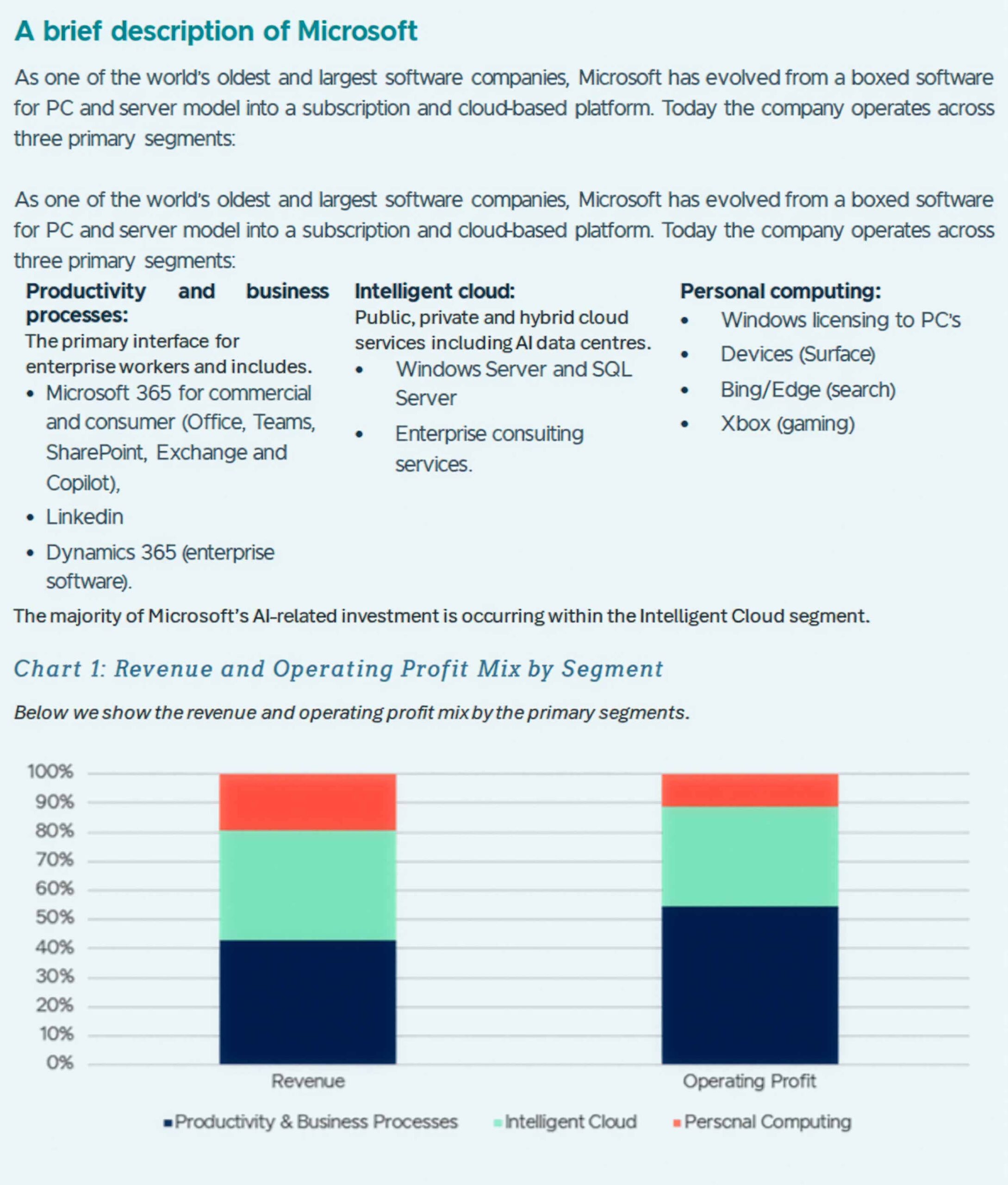
Before discussing AI-related disruption risk, it is useful to understand Microsoft’s operating structure.
Why we believe Microsoft’s software business remains resilient
In a previous article we explained why certain software companies possess characteristics that make them more resilient to AI-driven disruption. We referred to these businesses as “Systems of Record”, platforms that sit at the centre of critical enterprise workflows and data. Examples include SAP, Oracle, Workday. These businesses typically benefit from deep customer integration, high switching costs, trusted data architectures, and mission-critical functionality.
Microsoft’s core software businesses make up approximately 50% of group revenues and is considered an important enterprise productivity tool that shares many of the characteristics of Systems of Record. These include:
- Deep operational embedding: Microsoft’s products are integrated across workflows through Office 365, Teams, Outlook, SharePoint and Co-Pilot. This creates significant organisational dependence on its ecosystem.
- Powerful network effects: With approximately 450 million commercial users and 90 million consumer users, Microsoft’s collaboration and communication tools benefits from scale that is difficult for competitors to replicate.
- High switching costs: Microsoft represents a default productivity layer in many enterprises – meaning high switching costs relating to identity, document formats and security policies. This limits displacement from potential competitors, none of whom have to date, succeeded in gaining the scale of Office 365.
- Low relative cost: Productivity software typically represents a small proportion of enterprise IT budgets while supporting critical business functions.
- Platform advantages: Microsoft’s productivity tools increasingly benefit from integration with its growing cloud enterprise solutions.
- AI-driven efficiency gains: Microsoft can benefit from using AI internally to lower development costs and improve operational efficiency.
While AI will undoubtedly reshape software, we believe Microsoft’s core software franchises remain relatively well-positioned compared with many other peers.
If software disruption risks prove less severe than feared, the investment debate increasingly shifts towards whether Microsoft’s AI infrastructure spending can generate attractive long-term returns.
2. AI cloud growth: addressing the investment
The trajectory for AI datacentre build-out remains uncertain. However, by modelling a range of long-term outcomes, it is possible to assess the potential valuation and return-on-capital implications for Microsoft’s AI cloud business.
For the purposes of this analysis, we separate the AI cloud business from Microsoft’s traditional cloud storage operations.
Traditional cloud storage services have a relatively longer operating history that provides reasonable visibility into future medium-to-long-term growth, margins, and market penetration. The AI cloud business, by contrast, is characterised by substantial front-loaded capital investment and rapid capacity deployment. To establish a normalised valuation framework, we model conservative, base, and optimistic scenarios through to 2034, and value each using a discounted free cash flow (DCF) model incorporating a 10% cost of capital and an appropriate terminal free cash flow (FCF) yield. Key assumptions include:
- AI-related capital expenditure: Based on Bloomberg consensus estimates, we assume AI infrastructure accounts for approximately 85% to 90% of Microsoft’s total capital expenditure.
- Asset lives: We assume a six-year useful life for server racks (reflecting the upper bound of the standard 4-to-6-year industry range) and a 13-year useful life for the remaining datacentre infrastructure.
- GPU mix evolution: Over time we expect Microsoft to increasingly utilise its own custom silicon or alternative hyperscaler chips, reducing dependence on higher cost Nvidia architecture.
- Operating margins: Traditional cloud margins are typically in the upper 30% range (e.g., Amazon AWS and Microsoft Azure ex server products). By comparison AI-focused cloud operator CoreWeave guides long-term adjusted operating margins of 25% to 30%. We assume a 33% operating margin as our long term, normalised base case.
Valuation: AI cloud business
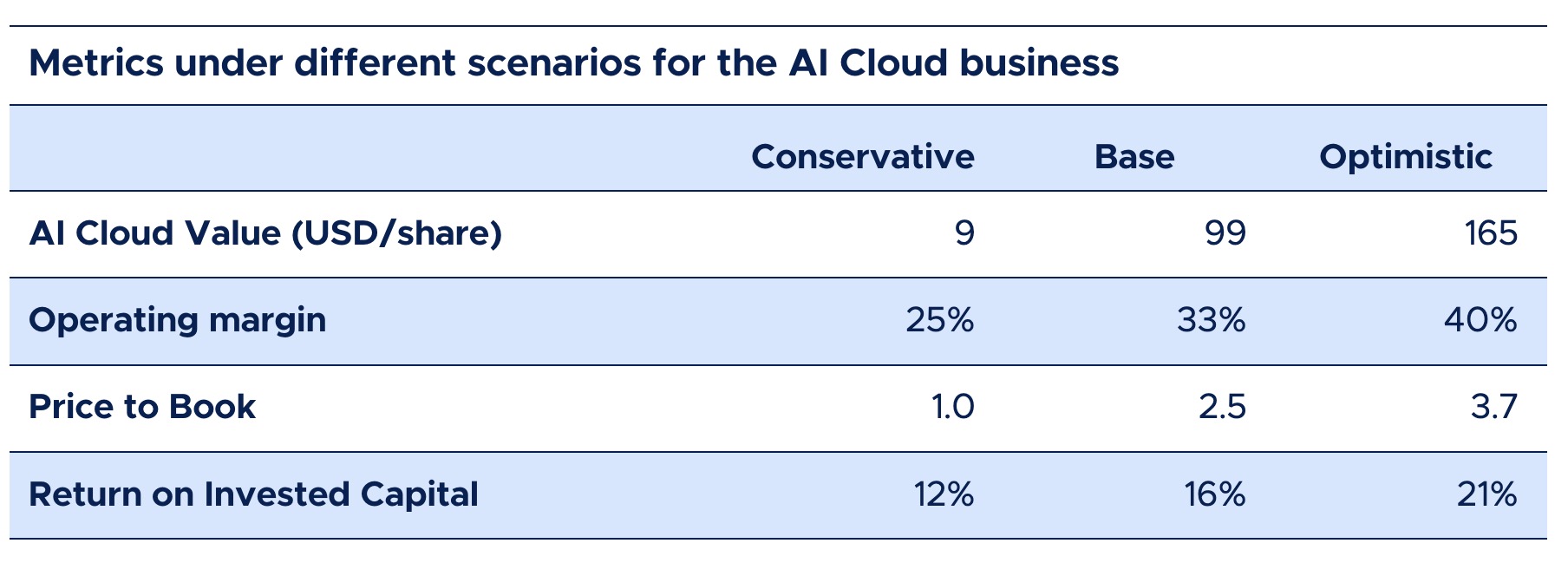
The table below shows various metrics at our conservative, base, and optimistic scenarios for the terminal value of the AI cloud business. We calculated this by flexing on operating margin and capex intensity assumptions. Our conservative scenario estimates ROIC at 12%, near the minimum we believe Microsoft would need to cover its cost of equity (which has historically been around 10%). Furthermore, the conservative scenario implies a price to book ratio of 1.0, suggesting the business is valued at no more than the value of the assets in our terminal year of 2034.
In the medium term, the AI cloud segment is likely to generate significant free cash flow losses.
The industry’s major hyperscalers are all investing aggressively in infrastructure ahead of demand, resulting in substantial capital deployment before revenues fully materialize. As a consequence, cash flow generation is likely to remain under pressure for a number of years.
Over the longer term, we expect the AI cloud business to stabilise. Although AI compute demand is clearly trending upward and the market appears capacity constrained, historical tech cycles suggest that periods of over-capacity are likely to follow. Market-clearing mechanisms typically resolve these imbalances through pricing and utilisation adjustments.
We believe the eventual industry structure is likely to resemble traditional cloud computing where hyperscalers like Microsoft will dominate and supported by scale, strong balance sheets, and highly cash-generative core businesses. Our long-term growth assumptions, include approximately 10x revenue growth over an 8-year period (comparable to Microsoft’s traditional cloud storage operations between 2017-2025). Additionally, because compute velocity (the speed of computations) is outrunning both token price deflation and GPU costs, we believe revenue intensity will continue to increase relative to plant and equipment. For valuation purposes, we apply an exit free cash flow yield of 5.5% to the terminal value for the AI cloud business, a discount vs the value we place on the rest of the group.
Microsoft group valuation
Below we show our sum of the parts value for AI cloud and the rest of the Microsoft group.
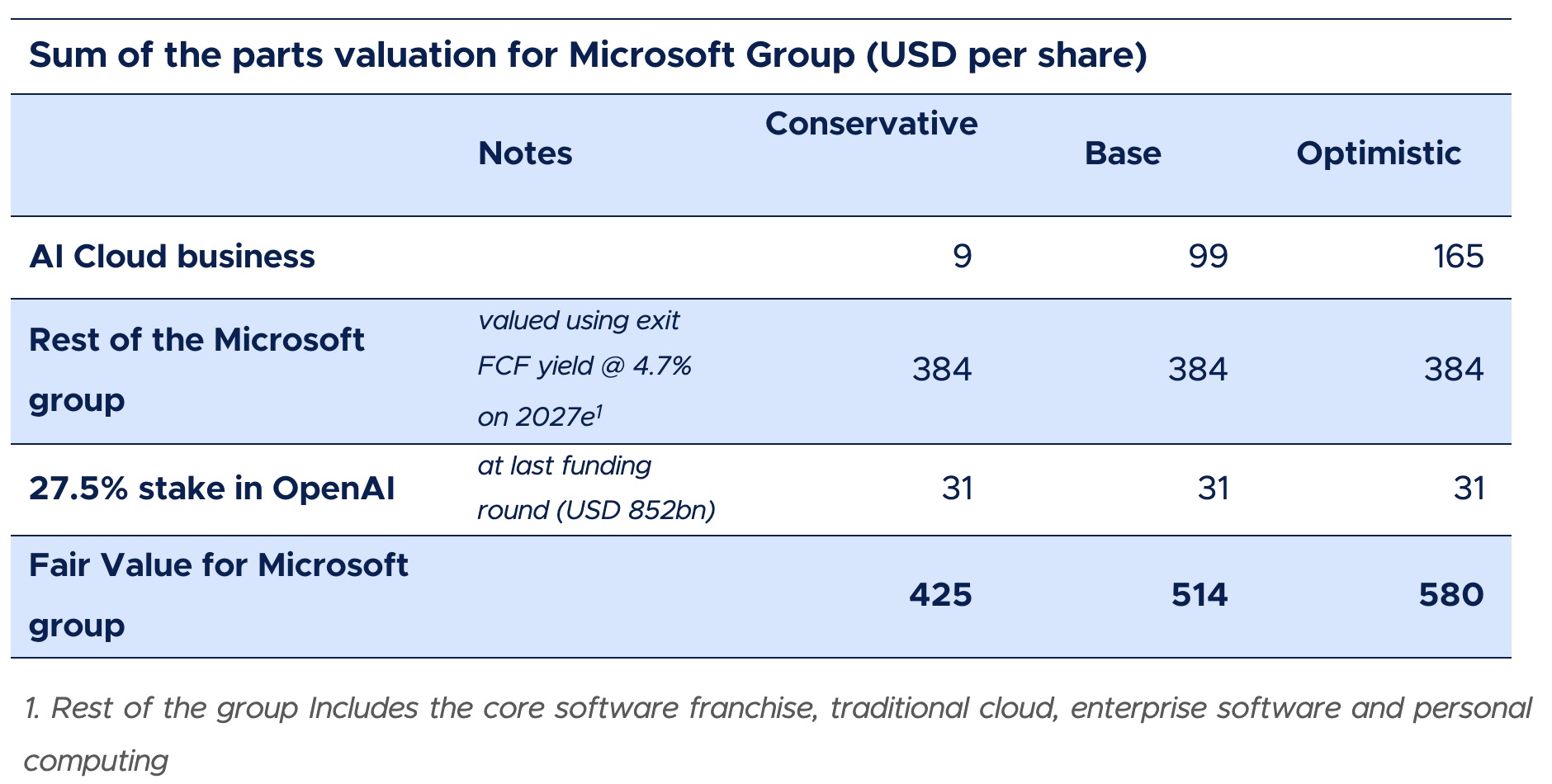
For the remainder of Microsoft’s businesses, we apply an exit free cash flow yield of 4.7% on 2027 estimates of free cash flow. This assumption is supported by Microsoft’s historical valuation range between 2015 and 2024, prior to AI monetisation. During this period Microsoft’s free cash flow yield averaged 4.7%, fluctuating between 2% and 7%.
Traditional cloud continues to grow at attractive rates (in the mid-teens) and remains highly profitable. Meanwhile, the software business appears relatively resilient to disruption risks.
What does this mean for the Microsoft Investment case?
While we don’t have a strong view on Microsoft’s 27.5% equity stake in OpenAI, the stake does not materially influence our estimate of Microsoft’s intrinsic value. At the current share price of USD 440 per share, Microsoft appears to be trading closer to the conservative end of our valuation spectrum. This suggests that investors are placing a relatively cautious value on the AI cloud opportunity while simultaneously discounting some of the strength of the company’s core software and traditional cloud businesses.
In our view, Microsoft’s established software franchises retain many of the characteristics that have historically supported durable earnings growth: deep enterprise integration, high switching costs, network effects and broad customer adoption. Traditional cloud remains a large, growing and highly profitable business.
The key uncertainty remains the ultimate economics of AI infrastructure. Questions around future returns, competitive intensity and industry capacity are legitimate. However, Microsoft’s scale, balance sheet strength and customer relationships position it favourably should the AI cloud market mature in a manner similar to traditional cloud computing.
As a result, we believe investors are protected on the downside given the defensive core software franchise and traditional cloud operations, while investors are paying the equivalent of an option value for the longer-term potential of the AI cloud business.