The market appears to have concluded that artificial intelligence (AI) is unlikely to enhance software platforms and is more likely to eventually replace them. The broad-based sell-off across global software stocks reflects growing market consensus that the sector faces an existential threat from AI.
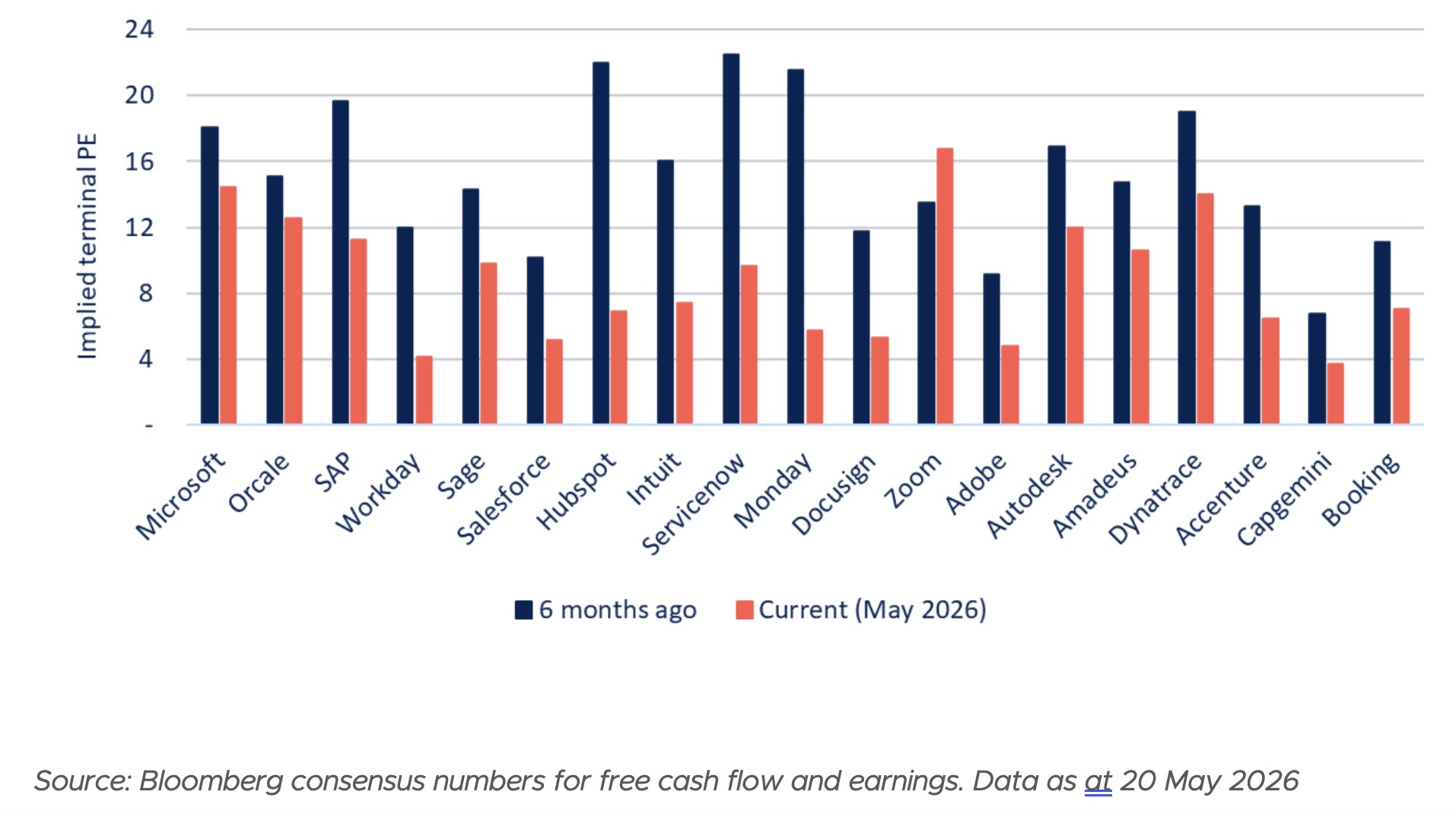
For years, the market has valued software companies based on a growing, recurring revenue model and durable competitive advantages. Today, investors are questioning this advantage and the terminal value of these businesses, resulting in a meaningful derating of value. The chart below shows that implied terminal PEs (based on 2030 consensus earnings estimates) have derated significantly over the past 6 months for what were once considered high-quality companies.
Chart 1: Software companies’ implied terminal PE value: then and now
The evolution of software: From mainframes to the cloud
To understand the gravity of fears about AI disruption, it is useful to consider how the industry has evolved.
In the pre-internet era, software was a fragmented, capital-intensive product delivered in “boxed” formats and installed on-premises. Customers were responsible for managing the underlying hardware infrastructure, often juggling disparate software vendors for the hardware, middleware, database and application layers.
The rise of the internet, high–speed broadband and later cloud storage transformed this model. Cloud platforms shifted hardware management away from customers, significantly reducing the cost and complexity of deploying software. This expanded the total addressable market for software, reducing barriers to entry for new competitors. However, while distribution and hosting became more efficient and centralised, the core development of the actual software remained a slow, labour-intensive, and expensive process. AI is now changing that dynamic.
The market sentiment: The erosion of the software moat
The current AI narrative challenges one of the software industry’s historical moats: the high cost and complexity of development. While the efficacy of AI across broader industries remains a subject of debate, its impact in software engineering is evident. AI-assisted coding tools have significantly reduced the marginal cost of writing and maintaining software code.
As development costs fall, the moat that once protected large software incumbents is disappearing. Investors are concerned about structural threats to the industry:
- Reduced differentiation as code becomes easier to generate, making proprietary features harder to defend.
- Increased competition as lower development costs enable the proliferation of niche, agile competitors.
- Pricing pressure from customers given the fading labour-intensive nature of software development.
This concern helps explain why many software businesses are now being valued less as durable recurring revenue platforms and more as potentially commoditised products.
Why the reality may be more nuanced
While concerns regarding AI-driven disruption are not entirely unfounded, the market may be over-generalising. We believe several structural factors protect parts of the software stack from being easily coded away:
- Core competency: Many corporates lack the appetite or expertise to build and maintain complex bespoke systems, even with AI assistance.
- Software complexity beyond code: True enterprise software involves far more than simply writing code. Software systems require continuous maintenance, security patching, adherence to shifting local and international regulations and deep integration across a broader IT ecosystem.
- Efficiency gains for incumbents: Established software companies stand to benefit from cheaper code generation, allowing them to accelerate product improvements, ship features faster and remain competitive.
- Proprietary Data: High-quality, proprietary data remains a critical advantage in an AI-driven world. This data currently resides within existing software architectures, positioning incumbents as the gatekeepers to the data required for AI analytics and agentic use cases.
We believe the impact of AI will vary significantly across software categories rather than affect the industry uniformly.
Understanding the spectrum of AI risk
Software is categorised into two primary domains. Infrastructure Software enables hardware to function, while Application software addresses specific business functions and is more vulnerable to competitive pressure from AI disruption.
Figure 1: Application software category framework: Steven Waldhauser
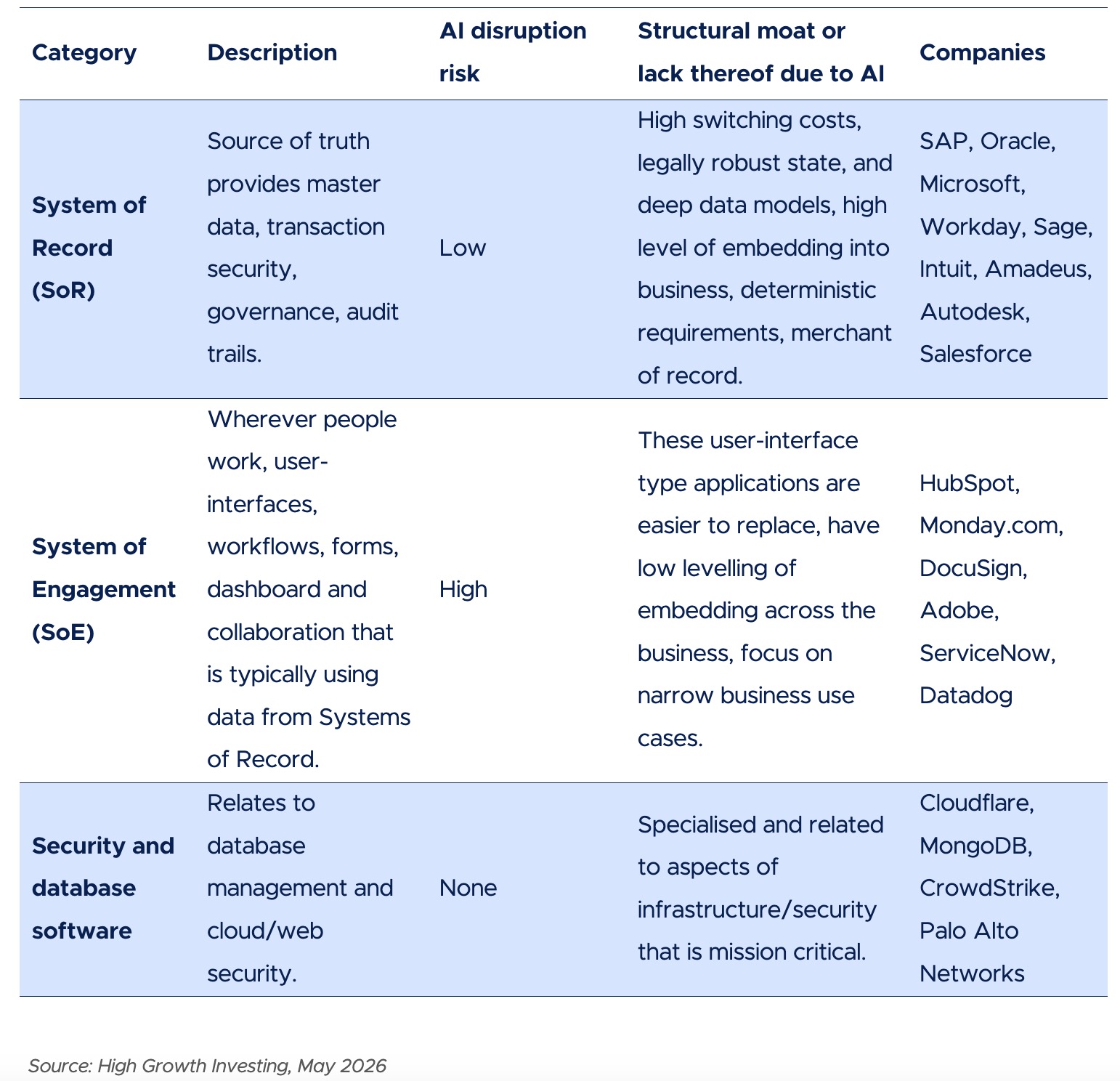
There is an additional category in this framework called “System of Intelligence” that sits between the layers of SoR and SoE and is designed to automate processes and workflows. This is an evolving category.
The SoR category includes embedded enterprise platforms with more favourable valuation characteristics and deeper structural moats against AI disruption.
Most companies would have at least one core system that houses central data and business processes and serves as the primary source for a business’s most critical data, including customer information, vendor lists, employee records, and financial and operational transactions. Examples include Enterprise Resource Planning (ERP) software like SAP, Oracle, and Workday2. We believe these businesses possess several characteristics that make them more resilient to AI disruption:
- Deep data models: These systems house decades of complex, domain-specific data and memory, which enable agentic AI tasks to be useful and accurate.
- Operational embedding: They are integrated into multiple business functions. A single transaction may trigger dependencies across supply chain, finance, and customer service modules simultaneously.
- High switching costs: Replacing these systems entails significant data migration risks, operational disruption, employee retraining, and reintegration into customer and vendor software.
- Institutional trust: In highly regulated industries, software is often selected based on years of proven compliance, security certifications, and operational reliability – features that are hard to replicate overnight.
In our view, these characteristics create structural advantages that are not easily displaced by lower software development costs alone.
The investment case for SAP SE (SAP)
Against this backdrop, we identified SAP as a compelling investment opportunity for our client portfolios.
SAP is the global leader in enterprise resource planning (ERP) software, operating across mission-critical segments including finance, supply chain management, human capital, customer experience and spend management.
Historically, SAP’s software was hosted on-premises, requiring significant upfront capital for hardware and licensing, as well as an internal IT support team. The business is now transitioning to a cloud-based platform that hosts the underlying infrastructure, shifting the customer from a heavy initial investment to a predictable annual subscription. Benefits for a customer adopting a cloud-based model include lower total cost of ownership, easier installations, centralised hardware hosting, instant software updates, and AI deployment that isn’t feasible on legacy on-premises hardware.
There are several specific catalysts that further support our investment thesis for SAP:
1. Double-digit cloud revenue growth runway
SAP remains relatively early in its cloud transition journey. Cloud-based ERP solutions with recurring subscription models typically generate higher lifetime revenue per customer than legacy on-premises models. In addition, SAP has set a 2027 deadline to end mainstream on-premises support (extended to 2030 with a premium surcharge), incentivising on-premises customers (>50% of ERP clients) to transition to the cloud platform.
The cloud model also expands SAP’s addressable market by making ERP solutions more accessible to small- to medium-sized businesses that previously couldn’t afford the upfront hardware and licensing costs of on-premises ERP. Furthermore, cross-selling opportunities exist, as a large portion of SAP cloud ERP customers use only a few of the available modules.
2. Margin expansion potential
As the Cloud ERP segment gains scale, we expect improved operating leverage with increasing gross margins and restructured sales incentives and marketing strategies, driving higher operating expense efficiency.
3. Shareholder-aligned management incentives
SAP has strengthened shareholder alignment by restructuring employee incentives, shifting to equity-settled grants, and tying executives’ long-term incentives to future cash flow (FCF) growth, including stock-based compensation costs.
4. Attractive valuation
We forecast medium-term cumulative annualised growth rate (CAGR) in cloud ERP of 20-25%, driving low double-digit group revenue growth and a medium-term EPS CAGR in the upper teens, given the operational leverage and share buybacks. We believe the current valuation multiple does not fully reflect the durability of SAP’s business model or the long-term earnings potential of its cloud transition.
Conclusion
AI is likely to reshape large parts of the software industry. Market concern and reaction have understandably placed pressure on software valuations. However, we believe the current market narrative risks treating software as a homogenous AI risk when the reality is far more differentiated.
Our investment in SAP reflects our view that businesses with deeply embedded customer relationships, proprietary data, mission-critical workflows and high switching costs may prove significantly more resilient than current valuations imply. SAP combines the relative resilience of a Systems of Record business with the growth potential of the ongoing cloud transition. This highlights what we believe is an attractive long-term valuation opportunity, given a double-digit revenue growth runway and a reasonable margin of safety in an increasingly uncertain software landscape.