Eighteen years since the business was founded, Truffle Asset Management manages more than R150 billion and has collected over 30 industry awards. Importantly the investment team has remained committed to consistent performance for our clients since inception, adopting a dynamic team-based approach to consistently deliver top quartile performance across our funds. Three factors underpin this record: a rigorous, disciplined philosophy applied consistently; an obsession with downside protection and avoiding permanent capital losses; and a willingness to stay nimble as circumstances change.
That flexibility matters, as the environment can change quickly and significantly. We believe three structural shifts are currently reshaping the investment landscape:
#1. a historic rebuild of European defence spending,
#2. a change in what is driving demand for industrial metals, and
#3. the unwinding of three decades of globalisation.
Defence spending
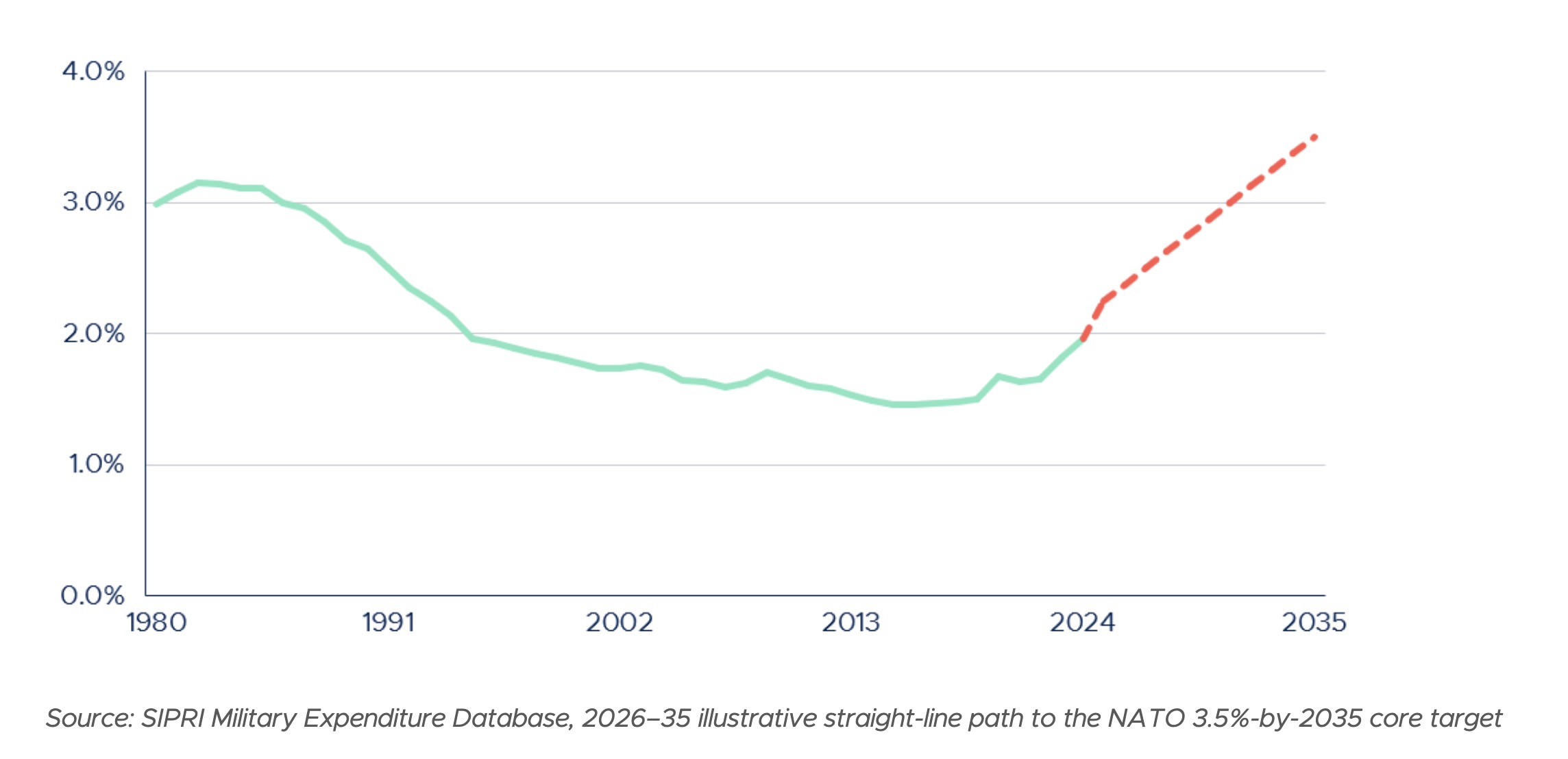
For most of the post-Cold War era, European governments treated defence spending as discretionary, comfortable under the NATO security umbrella. Russia’s 2022 invasion of Ukraine, combined with renewed uncertainty over Washington’s long-term NATO commitment, shattered that assumption. We expect European defence spending to keep rising toward 3.5% of GDP by 2035. A new “Buy European” drive also aims to lift the share of defence procurement sourced within Europe from around 25% in 2022 to 50% by 2030 and 60% by 2035, supporting government spending growth of more than 10% a year for a decade. Modern warfare also centres on air and missile defence, surveillance, drones, sensors and cybersecurity rather than tanks and artillery, a distinction that matters for positioning, whether through primes like Airbus and Leonardo or specialists such as Dassault, Safran and Indra.
Chart: European defence spend as a % of GDP
Metal demand
The story behind metal demand is also changing. For decades, it was largely about Chinese urbanisation and construction. The next chapter is different: electric vehicles use roughly three times more copper than petrol vehicles, renewables require far more cabling, and data centres consume enormous volumes of copper and cooling infrastructure. Supply is struggling to keep up, ore grades are declining, costs are rising, discoveries have slowed sharply, and the largest producing countries (Peru, Chile, the DRC) carry real operational risk. New mines take a decade or more to build, pointing toward widening deficits ahead. A structurally weaker US dollar, driven by large fiscal deficits, adds further support for real assets including copper and gold.
Deglobalisation
Thirty years of globalisation delivered cheap goods, low inflation, low rates and rising asset prices, underpinned by a stable, US-led world order. That environment is reversing: countries now prioritise security of supply over efficiency, tariffs and onshoring are back in favour, government deficits sit at record highs even as defence and infrastructure spending needs grow, and the world is shifting toward a more fragmented, multipolar order. Yesterday’s assumptions can no longer safely guide tomorrow’s decisions.
In this environment, we believe genuine diversification and downside protection matter more than ever. The Truffle SCI Flexible Fund has historically captured about 70% of market upside while capturing only around 28% of the downside, built through diversified, fundamentals-driven stock selection rather than large macro bets.
Being prepared
There is a useful precedent for this kind of flexibility. In December 1944, General George Patton was advancing east toward Germany, a logical plan, when he recognised that events unfolding in the Ardennes required a change of course. Within 48 hours he had turned his army 90 degrees north and, a week later, relieved the besieged town of Bastogne. His success did not result from predicting the future perfectly, but from staying alert and acting decisively once the facts changed.
Similarly, in managing portfolios, Truffle recognises that while we cannot be certain of what lies ahead, we can apply the same philosophy while changing our positioning to ensure portfolios deliver consistent performance over time. Investment landscapes evolve and we need to think and act differently.