The US healthcare industry has been central to many global debates, largely due to its complexity and high costs relative to other developed economies. While that debate remains important, this article focuses on how the US healthcare system is funded (private and public) and where we see investment opportunities emerging within the health insurance sector.
Understanding the US health insurance industry
Health insurance coverage in the US
US healthcare expenditure reached approximately $5 trillion in 2024, equating to around $15,000 per capita, almost double the average spend across developed market countries. Healthcare insurance to cover this level of spend is largely supported by private and government programmes. The chart below shows a breakdown of the US health insurance programmes.
Chart 1: Health Insurance coverage by product (% US Population, 2024)
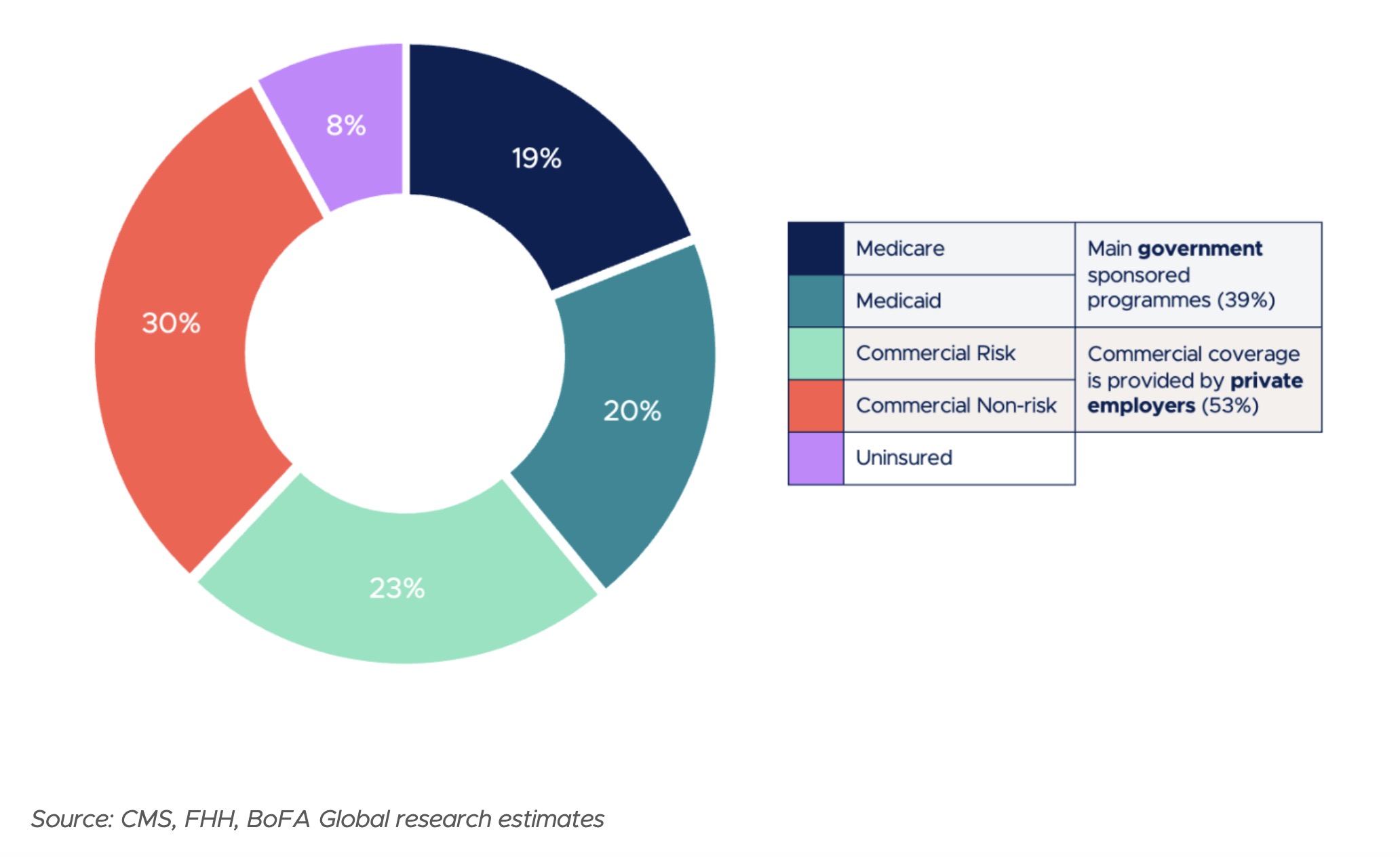
Nearly half of the US population is covered by commercial (employer-sponsored) insurance, the bedrock of the American healthcare system. Commercial coverage can be split into two primary product types:
- Commercial non-risk: Employers underwrite the health coverage of their employees while health insurance companies provide administrative services for a fee.
- Commercial risk: Health insurance companies underwrite employees’ health coverage and assume medical risk in exchange for premiums.
Both programmes are funded by employers, with most having some form of member co-payment.
Government-sponsored programmes form the other major segment of insurance coverage and can be categorised into two key programmes:
- Medicare: primarily for those aged 65 and older and covers 19% of the US population.
- Medicaid: provides essential health insurance for low-income individuals and covers 20% of the population.
Health insurance for those who do not qualify for employer or government programmes can be accessed through public individual exchanges. The Affordable Care Act reshaped this system by mandating affordable cover for essential benefits irrespective of pre-existing conditions. As shown in the chart above, despite these channels, approximately 8% of the US population remains uninsured.
Managed Care Operators (MCO) and their evolution
Health insurance companies in the US are locally referred to as Managed Care Operators (MCOs). Their essential function is to administer health insurance plans by designing benefit structures, processing medical claims, and negotiating unit costs with healthcare providers such as hospitals, physicians and laboratories to earn an underwriting margin.
MCOs also support government programmes. They currently underwrite approximately 50% of Medicare (under the Medicare Advantage programme) and 75% of Medicaid members. The remaining members are underwritten directly by the government.
The table below provides a detailed breakdown of the core MCO market.
Table 1: Key segment metrics for Managed Care Operators (MCOs)
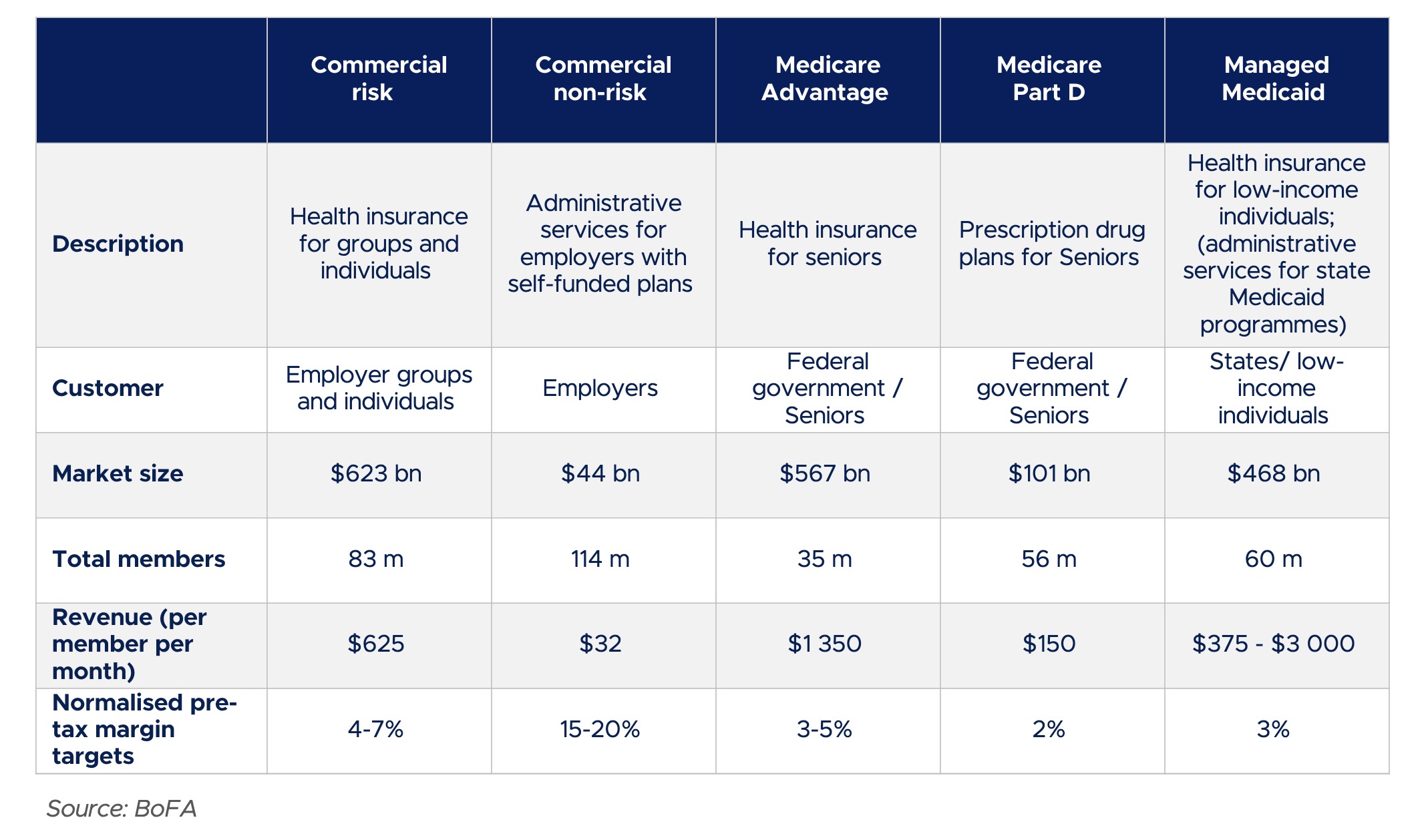
The traditional fee-for-service model offered by MCO’s incentivised volume over quality; however, this has steadily shifted to a value-based care and capitation model. This model shifts the financial risk, and MCOs partner with physicians to achieve quality clinical outcomes and stringent cost control. At the same time, major MCOs have diversified beyond insurance to vertically integrate and capture a larger share of the patient economics through other services.
Pharmacy Benefit Managers (PBMs) are a vital segment of these additional services, handling 87% of all US prescriptions, negotiating drug rebates with pharmaceutical manufacturers, managing vast pharmacy networks, and administering mail-order delivery services.
MCOs have also expanded into direct care delivery, healthcare technology and data analytics. The former includes ownership of medical practices and the provision of behavioural health services and home care. These non-insurance segments are highly attractive and grow faster, face less regulatory scrutiny, and typically generate superior operating margins.
Recent industry pressures
The past few years have been unusually turbulent for the sector.
1. Covid-related distortions
During the Covid pandemic, Medicaid membership increased by more than 20 million members due to the suspension of eligibility checks. As the pandemic ended and these eligibility checks resumed, MCO’s experienced two significant challenges:
- Post-pandemic redeterminations removed healthier members, leaving MCOs with a much higher acuity (more complex and sicker) member base and less premium revenue. Medicaid membership sharply declined as eligibility reviews by US states resulted in fewer people meeting the income and job requirements for membership.
- Healthcare utilisation and medical inflation surged as Covid restrictions eased, adding to the MCO’s financial strain.
2. Regulatory headwinds
A number of regulatory changes have added to industry challenges:
- The Inflation Reduction Act (IRA) shifted more of the drug cost burden onto insurers (MCOs) by capping Medicare Advantage out-of-pocket drug costs.
- Regulations reduced Medicare Advantage reimbursement rates by reducing premiums paid for riskier patients. Historically, Medicare members were coded based on illness diagnoses, and MCOs received higher premiums for members with higher patient acuity, as determined by their coding status. However, regulations have made the coding process complex, limiting the ability to earn higher premiums as before.
- The One Big Beautiful Bill, projected to slash Medicaid spending by over $700 billion over ten years, imposed stricter eligibility requirements, implying the removal of 8 to 10 million members from Medicaid. Additionally, reduced subsidised coverage could push another 5 million individuals out of the private individual market.
- Recently, expected regulations on Pharmacy Benefit Managers (PBMs) will force a 100% pass-through of drug rebates to health plan members. This will lower the margin MCOs have historically earned; however, it is still expected to remain a profitable and fast-growing segment.
3. Impact on margins and profitability
The expiration of pandemic-era protections and mounting regulatory challenges have resulted in a meaningful deterioration in industry profitability:
- Medical Loss Ratio (MLR), the percentage of premiums spent on medical claims, has spiked to c.90% (from 80-85%).
- Claims and overall utilisation remain elevated across the entire industry, driven by pent-up demand and complex chronic care needs after the pandemic.
- Surging medical costs compressed MCO operating margins, particularly in government programmes. State Medicaid rate updates and federal Medicare Advantage funding lagged real medical inflation and utilisation.
Companies with heavier exposure to government programs (Medicaid and Medicare Advantage) experienced greater margin pressure, while more diversified MCOs were partially insulated by faster-growing, unregulated non-insurance streams.
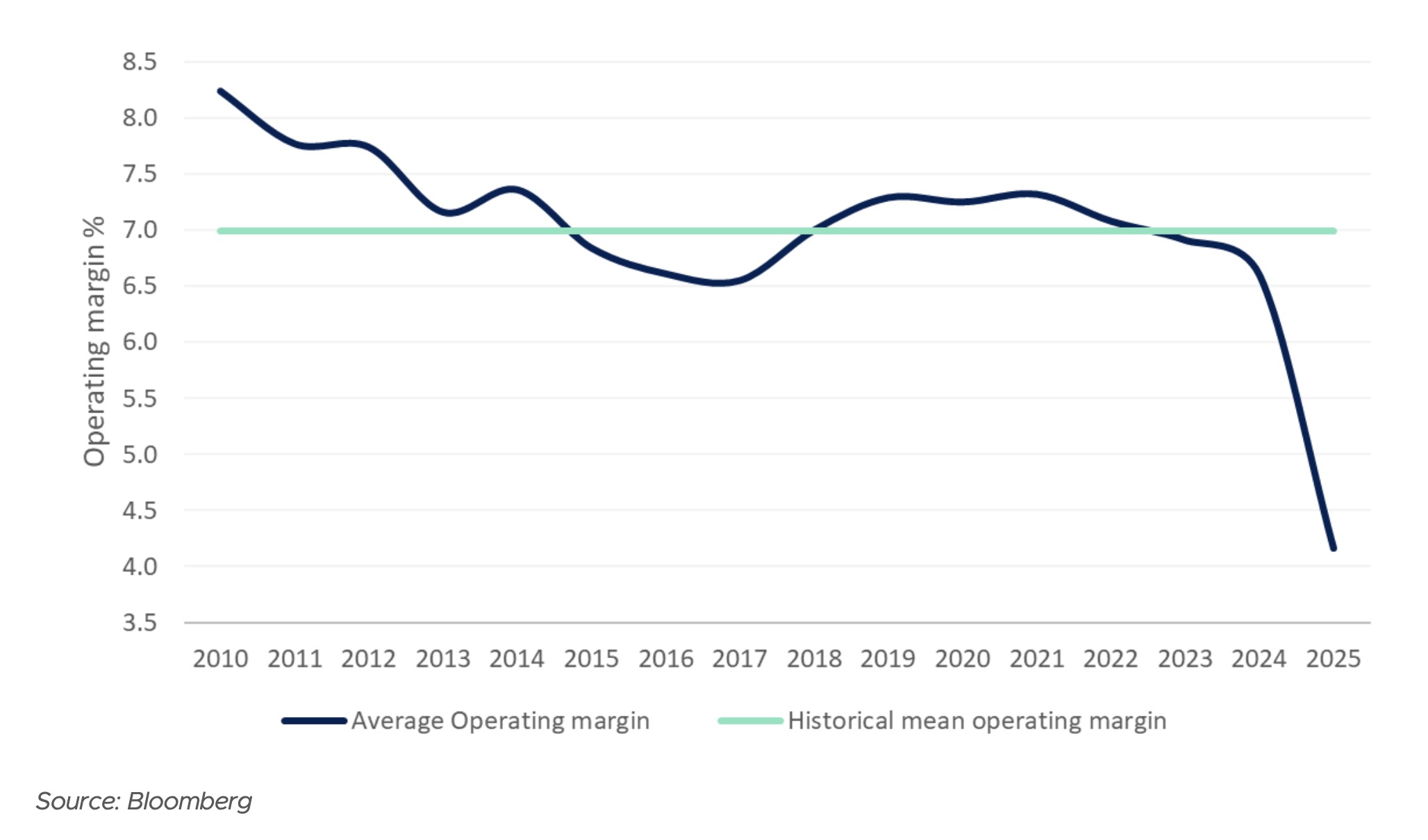
The chart below shows the decline in operating margins for large, diversified US health insurance peers over recent years.
Chart 2: US Diversified health insurance average operating margins
MCO’s response to pressure
Historically, the industry has demonstrated an ability to adapt through several levers:
1. Pricing discipline.
MCOs reprice their commercial premiums relatively quickly to match newly observed cost trends and recover margins. Government programmes are slower to adjust as they set rigid annual pricing timelines, and therefore, MCOs underwriting government often face short-term margin pressure.
2. Network management
Where pricing adjustments may not be quick, MCOs strategically respond by altering programme benefits, reducing physician/hospital network breadth to increase bargaining power, or entirely exiting unprofitable regional markets to protect profitability.
3. Utilisation control
Pivoting to managed network plans and implementing stringent medical management tools such as prior authorisations and differential co-payments, which effectively steer patients toward lower-cost care settings.
4. Structural evolution
Transitioning away from volume-driven fee-for-service models toward value-based care (like the network plans we know in South Africa) and capitation arrangements, which transfer financial risk directly to physicians and incentivise long-term cost containment.
Additionally, major MCOs have diversified into less regulated, high-margin non-insurance services. By vertically integrating into Pharmacy Benefit Managers (PBMs), direct care delivery and data analytics, MCOs capture a larger share of the healthcare dollar and shield earnings from underwriting volatility.
MCOs also leverage their massive scale and Selling, General and Administrative (SG&A) efficiencies to absorb compliance costs and opportunistically consolidate fragmented markets when smaller peers struggle with regulatory burdens.
Investment view: opportunity in dislocation
We believe current pressures are cyclical rather than structural, and while earnings have deteriorated, recovery efforts towards a base of normalised earnings create an attractive investment entry point into leading, diversified MCOs such as UnitedHealth Group (UNH) and Elevance Health. The key drivers of recovery are outlined below:
Pricing catch-up: To correct recent margin compression, both UNH and Elevance are aggressively repricing premiums. UNH is repricing its commercial employer book to a 10% cost trend, while Elevance is pushing individual market pricing up by over 20% year-over-year. Medicaid price trends are still below cost trends; however, these and utilisation are expected to normalise in 2027, while Medicare Advantage pricing is expected to take longer to normalise.
Operational discipline: These businesses are actively exiting unprofitable regional markets, altering benefit designs, and targeting reductions in general sales and administrative costs, with UNH planning $1 billion in cost cuts for 2026.
Cost-of-care management: Both companies continue to shift towards value-based care and capitation arrangements, improving their buying power and reducing the cost of care.
Industry consolidation and vertical integration: Many regional and smaller MCOs face balance-sheet problems, while larger players like UNH and Elevance can gain membership and scale advantages. Furthermore, vertical integration, including non-insurance businesses in pharmacy benefits and care delivery, has become more critical for extracting efficiencies.
Valuation: Multiples have meaningfully de-rated due to cyclically depressed earnings.
- UNH historically commandedapremium price-earnings (PE) multiple, averaging 18.1x, and is now trading around 14x on depressed earnings.
- Similarly,Elevance,which traditionally traded at a discount of around 14x, has compressed to about 10x forward PE.
Looking ahead, we believe improvements in the Medical Loss Ratio (MLR), market consolidation, and cost levers should drive low double-digit EPS growth and a multiple rerating in the medium term.
The current environment reflects a period of cyclical stress driven by post-pandemic distortions and regulatory change. However, the structural advantages of scale, integration, and pricing power remain intact.
For long-term investors, this dislocation presents an opportunity to gain exposure to high-quality operators at more attractive valuations.