
On 29 January 2012, Novak Djokovic and Rafael Nadal battled for nearly six hours in the Australian Open final, the longest Grand Slam final in tennis history. By the end, both players needed chairs brought onto the court for the trophy ceremony. It wasn’t just a match; it was a display of physical and mental resilience unlike anything tennis had seen.
Afterwards, Djokovic claims he sat in the locker room craving one thing: chocolate. Given a strict diet, he hadn’t had chocolate in over 2 years. When his coach handed him a slab, Djokovic broke off a single piece. “That was all I would allow myself,” he said later. “That is what it has taken to get to number one.”
This story captures the essence of greatness, not one grand act, but the accumulation of many small, disciplined choices. In sport, as in investing, the difference between winning and losing often lies in marginal gains: doing many things slightly better than everyone else.
At Truffle, we believe the same principle defines long-term investment success.
Building a winning legacy
When I joined the business in 2013, Truffle was a small boutique asset manager with R1.2 billion in assets under management. 17 years later, we have steadily grown our client base, managing significantly more and importantly, over this time, we have been recognised with more than 30 industry awards. Growth has not come from one big idea or one great year. Truffle’s growth results from years of consistency, discipline, and the relentless pursuit of incremental improvement.
Just as Djokovic’s greatness stems from excelling across every dimension of his game, Truffle’s success is rooted in a disciplined investment process focused on long-term fundamentals, downside protection, and avoiding the “bombs.” We continue to learn lessons along the way, and across every mandate, we strive to achieve small wins that compound into exceptional results.
Lesson 1: Endurance Wins the Long Game
Up until 2010, Djokovic was known for retiring mid-match. Critics called him a quitter. Then he transformed his approach, switching to a gluten-free, plant-based diet and cutting out sugar entirely. The result? His 2011 season is still considered one of the greatest in history: three Grand Slam titles and the start of his dominance in tennis.
By age 38, Djokovic remains a top contender, while legends like Pete Sampras, Andre Agassi, and Andy Roddick all retired years earlier. His longevity is a testament to physical strength and discipline. He wins not with flashy shots, but by outlasting opponents point after point, match after match.
Similarly, consistent outperformance in investments is achieved not through one-off “hot streaks” but by playing the long game, focusing on compounding, risk management, and avoiding costly mistakes.
“At Truffle, our focus on downside protection and capital preservation has enabled our flexible fund mandates to capture more than 70% of market upside while limiting downside to as low as 29% since inception.”
At Truffle, our focus on downside protection and capital preservation has enabled our flexible fund mandates to capture more than 70% of market upside while limiting downside to as low as 29% since inception. This translates to strong inflation-beating returns with the Truffle SCI Flexible Fund achieving an annualised return of 13% since its inception in January 2011 to October 2025. The result: long-term wealth creation built on endurance and discipline.
Lesson 2: Adaptability Keeps You in the Game
In 2017, Djokovic’s career nearly derailed due to an elbow injury. When he returned in 2018, he realised he needed to evolve his game. He shortened rallies, improved his serve, came to the net more often, and added variety with drop shots. His first-serve aces rose significantly, and net approaches nearly doubled. Even after 12 Grand Slam titles, Djokovic continued to adapt, refusing to be limited by past success.
In investing, flexibility is equally vital. Markets shift, policies change, and sentiment can swing overnight, particularly in South Africa’s volatile environment. A rigid “buy-and-hold” mindset doesn’t always work. Shares like Mr Price have strong fundamentals and, despite being a quality company, have struggled to deliver compelling returns over the last 10 years. However, long-term success depends on timing, adaptability, and the ability to recognise changing conditions.
At Truffle, our nimble structure allows us to reposition portfolios quickly yet thoughtfully. During the 2024 SA elections, for example, we identified the positive implications of the GNU, lower inflation, and interest rate cuts for apparel retailers. A further benefit for consumers (and therefore the retail sector) in 2024 was the introduction of the two-pot retirement system. We increased our exposure to the sector, captured strong performance into year-end, and then rotated out when valuations reached fair value. This flexibility enabled us to generate 1.6% alpha in flexible mandates over a 12-month period.
Agility, not rigidity, is what keeps portfolios resilient.
Lesson 3: Mental Strength Separates the Good from the Great
Of all Djokovic’s traits, his mental toughness sets him apart. Growing up during the Yugoslav wars, he trained under bomb raids, his family struggling to make ends meet. That adversity forged his resilience. On court, he never crumbles, saving match points and thriving under pressure.
Roger Federer once revealed that even he, one of the greatest ever, won only 54% of all points he played in his career. The difference between great and exceptional lies in how quickly you recover from the points you lose.
In investing, mental strength plays the same role. Everyone in this industry is intelligent. What separates the best from the rest is emotional control. The ability to stay calm amid volatility, to reassess rather than react, and to accept mistakes without ego is critical.
At Truffle, we embrace humility, discipline, and continuous learning. Our investment process has evolved over time, not through overhaul, but through refinement, shaped by lessons learned from both wins and losses.
Small margins, big outcomes
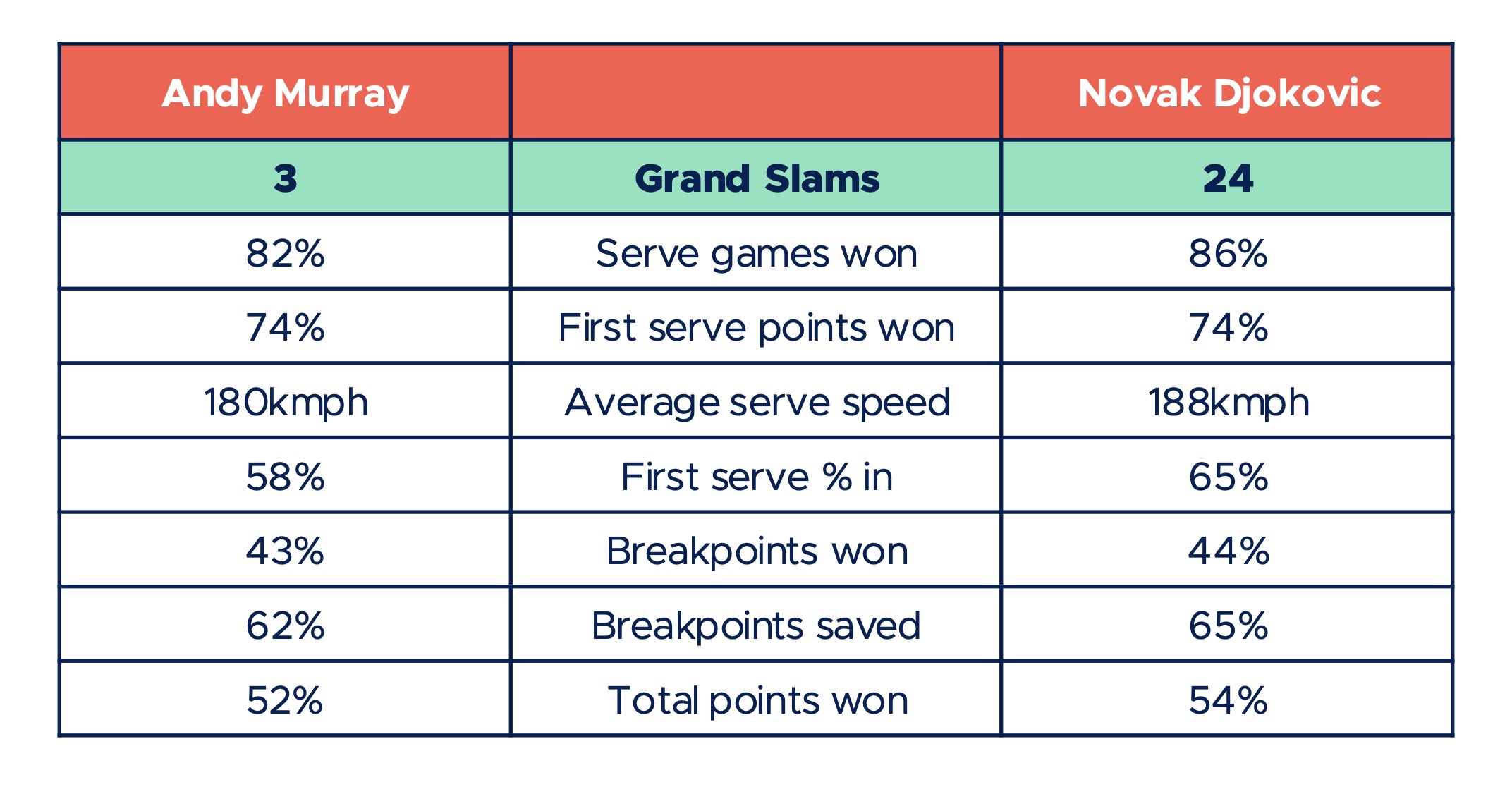
The comparison between Djokovic and his rival, Andy Murray, illustrates the point. Across most statistics, first-serve percentage, break points, and total points won, Djokovic is only marginally better. Yet those tiny advantages have compounded into 24 Grand Slam titles versus Murray’s three.
Similarly, when it comes to investing for long-term financial outcomes, success isn’t about one perfect call; it’s about consistently making small, smart decisions. This means reducing costs, staying composed, avoiding emotional trades, and improving every aspect of the process by 1% at a time.
Like tennis players, who are measured by Grand Slam titles, fund managers are measured by long- term performance. Since its inception, the Truffle SCI Flexible Fund has delivered strong, risk-adjusted returns by providing equity-like growth with significantly lower volatility, an ideal balance for clients approaching or in retirement who need both stability and real returns.
Point by point, win by win
One point might seem small. But point by point becomes a set. Sets become matches. Matches become legacies. Small investments that avoid losses, consistently compounded over time, lead to extraordinary outcomes.
Success isn’t a single defining moment. It’s the accumulation of disciplined choices, refined decisions, and relentless consistency. Whether on a tennis court or in financial markets, greatness is built point by point.