South Africa has spent much of the past decade dealing with a difficult combination of weak growth, rising debt and declining investment. National Treasury’s 2026 Medium-Term Budget Policy Statement (MTBPS), however, suggests that we may be approaching an important inflection point.
Progress on stabilising public finances is encouraging. But stabilisation alone is not enough. The next challenge is turning that hard-won fiscal stability into stronger economic growth, and that means getting infrastructure investment right.
Stabilising debt and expenditure growth
Investors spent a fair amount of time at the start of this decade addressing clients’ very rational concerns that South Africa was heading towards a debt spiral. That analytical skillset has since proved surprisingly handy in assessing the risks facing some of the world’s most liquid developed-market sovereigns.
But South Africa made it through.
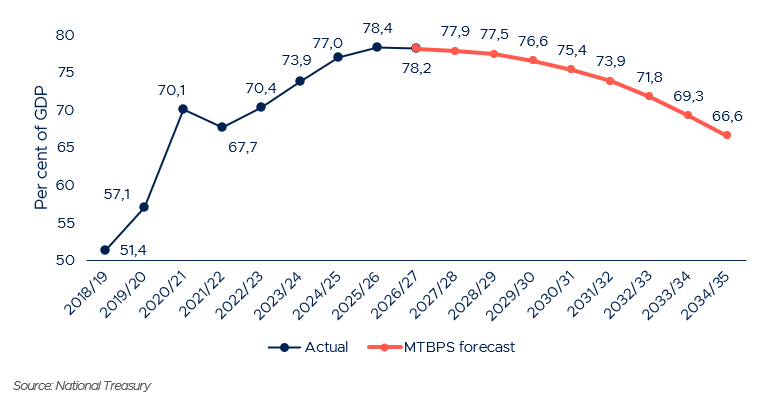
That is due in no small part to the high-calibre team at National Treasury, particularly its Budget Office. Debt-to-GDP stabilised at 78.4% in February 2026 and has since eased to 78.2%. This was achieved through expenditure-led fiscal consolidation—no small feat in a country where unemployment remains stubbornly high at 33.6% in Q2 2026.
Chart 1: South Africa’s Debt-to-GDP
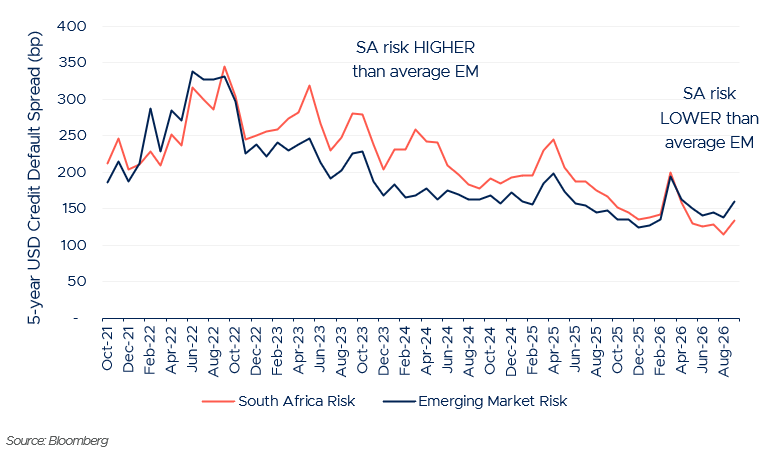
For investors, this progress has mattered. South Africa’s country-risk premium has compressed, helped by a generally supportive environment for emerging markets as well as a more positive domestic story. A narrower credit default swap (CDS) spread translates into lower borrowing costs for the country and, importantly for investors, stronger bond returns.
Chart 2: South Africa’s country risk improves in 2026
But there is still a long way to go.
The improvement has not yet been enough to restore South Africa to investment-grade credit status. Regaining that status would be significant, potentially attracting substantial additional capital into both our financial markets and the country through foreign direct investment. However, a return to investment grade is unlikely without materially raising our potential growth rate from the current 1%-1.5% level closer to 3%.
More importantly, fiscal consolidation cannot indefinitely substitute for economic growth. We know structural reform is needed to lift the growth rate, and even with a Treasury team and a current administration committed to maintaining primary surpluses, real growth below 3% is simply not enough to materially improve either our debt metrics or the wealth of South Africans.
There is also very little room to manoeuvre within government spending. Nearly 70% of non-interest revenue is still directed in spending towards what is broadly referred to as the “social wage” — health, education, social protection, housing, community development and employment programmes.
So, stabilising the debt burden was essential. It reduced the risk of a debt spiral in which the government pays increasingly high interest rates on an increasingly large debt stock.
With our debt trajectory stabilised, the next step is growth. And that brings us to infrastructure.
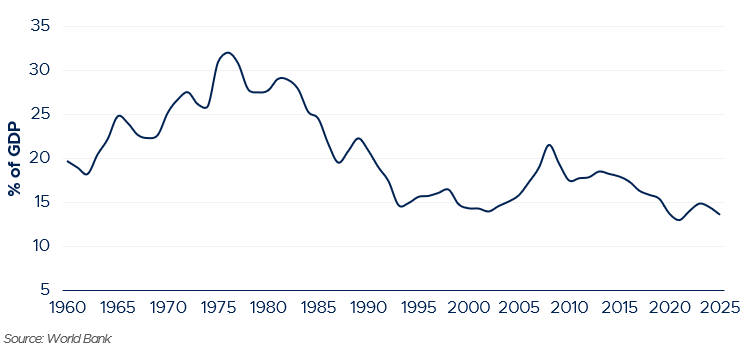
Chart 3: South Africa historical Gross Fixed Capital Formation as % of GDP
Infrastructure-led growth
South Africa has a significant infrastructure backlog, and our investment rate has been falling for years.
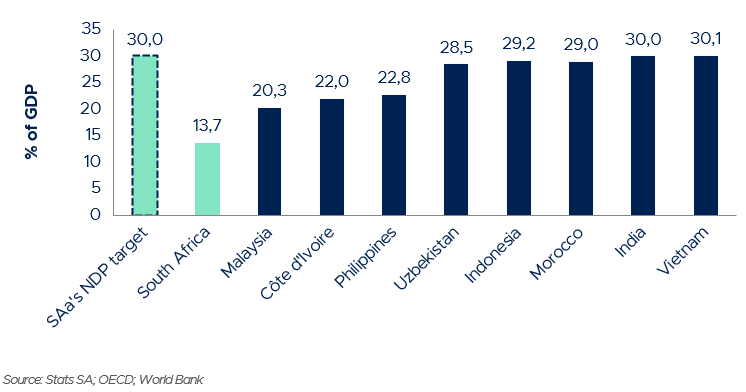
Gross fixed capital formation has been in chronic decline and, at 13.7% of GDP, South Africa invests materially less than similarly rated emerging-market peers. Of that 13.7%, the state accounts for roughly 4.0%, while the private sector contributes around 9.7%.
Chart 4: Investment rates: South Africa vs similarly rated peers growing above 3%
The problem, however, is not simply that we are investing too little. We have also been getting too little out of what we do invest. The IMF estimates South Africa’s infrastructure efficiency gap at around 38–40% relative to peers. In other words, the effective investment rate is materially worse than the headline 13.7% suggests: we are spending less than our peers and getting less for each rand spent.
There is another wrinkle. South Africa will rebase its GDP before the end of October 2026, as the economy’s size is remeasured every five years. This will improve the debt-to-GDP ratio, but it will also make our investment metrics look even worse.
The challenge is therefore clear: we need to invest more, but we also need to become much more efficient with the capital that we spend. And, of course, we cannot spend what we cannot afford. We therefore need a credible way to crowd in private capital alongside government infrastructure spending.
This is not lost on the current administration or National Treasury. The MTBPS is an encouraging step forward.
A better way to spend
In this MTBPS, R18.7 billion in revenue overruns (revenue collected ahead of the budget) was allocated to the Budget Facility for Infrastructure (BFI). That is positive for two reasons.
First, it does not create a permanent increase in the expenditure base, which makes the allocation fiscally responsible. Second, it does not serve as another bailout for state-owned enterprises, where capital expenditure has historically been particularly inefficient. Few examples illustrate this better than the roughly R286 billion spent building the Medupi and Kusile power stations, against an original budget of R160 billion.
The BFI is, in essence, National Treasury’s attempt to put a technical gate between a project idea and public money.
Established in 2021, it is a joint arrangement between National Treasury, the Presidential Infrastructure Coordinating Committee and the Department of Planning, Monitoring and Evaluation. It has since approved 41 projects, with allocations totalling R96.1 billion, and momentum has built significantly during the current fiscal year. The additional R18.7 billion allocated in this MTBPS should accelerate that process.
Importantly, the BFI is also becoming more responsive. Since 2025, it has moved from a single annual funding window to quarterly evaluations. This lets Treasury build a pipeline of investment-ready projects rather than scrambling for funding once a year.
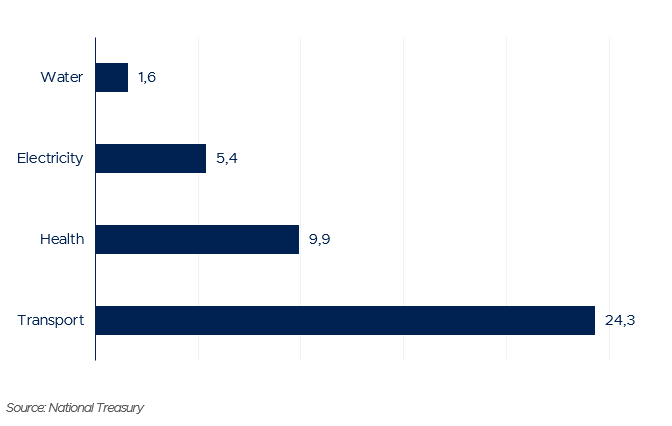
And the demand is clearly there. In the latest funding window alone, Transnet applied for roughly R17 billion across three rail and port programmes, SANRAL applied for R7.3 billion for three road upgrades, while national and provincial health departments applied for a further R10 billion for hospital replacements.
Chart 5: BFI requests Q2 FY26/27 window (R41 bn total)
What makes the BFI particularly interesting is that it can attach conditions to a project before funds are drawn down, linked to both pre-project and in-project milestones. Probity auditors are also appointed during the procurement process, so they can assess a tender’s integrity while it is taking place rather than after the money has already been spent.
This addresses the risk of inefficient spending much earlier in the process — when problems are still relatively cheap to fix. If a project cannot demonstrate it is ready to proceed, the next tranche of funding is not released, and the money remains in the fiscus.
That staged approach is a meaningful change and, if implemented properly, should reduce losses from inefficient capital spending.
From good intentions to execution
The missing ingredient has arguably been capability rather than intent. This is where the Infrastructure Finance and Implementation Support Agency (IFISA) comes in.
Housed within the Development Bank of Southern Africa, IFISA consolidates project preparation, appraisal and public-private partnership functions that were previously spread across Treasury, the Government Technical Advisory Centre and the DBSA’s Infrastructure Fund.
Its role is essentially to get projects to the standard required by the BFI and then help them survive the realities of implementation. It is not compulsory — a project sponsor can approach the BFI directly — but projects that work with IFISA have a markedly higher success rate. That tells us something important about where the real constraint lies.
Together, the two institutions provide a sensible division of labour: IFISA helps build the project; the BFI tests it and releases funding against evidence of delivery.
The opportunity — and the test
Whether all of this will be enough to lift South Africa’s investment rate from 13.7% of GDP towards the National Development Plan’s 30% target is another question entirely. But perhaps that is not the immediate test.
The more pressing question is whether already allocated money can finally translate into built infrastructure.
The MTBPS suggests that the architecture for doing this is improving. Fiscal consolidation has helped stabilise the debt trajectory, while the BFI and IFISA provide a more disciplined framework for getting infrastructure projects from concept to completion.
Now comes the hard part: execution.
If these mechanisms work as intended, they could do more than improve public-sector infrastructure. They could crowd in private investment, improve productivity, and, importantly, shift investor sentiment toward South Africa.
We have spent years putting public finances on a more sustainable footing. The opportunity now is to use that stability as a platform for growth.
The inflection point may be taking shape. The question is whether we can build it.