In an uncertain market environment, income funds can offer investors an attractive balance between yield, capital preservation and liquidity.
Financial markets this year have been shaped by conflict in the Middle East, volatile oil prices and rising government bond yields across the globe. High levels of government indebtedness and persistent inflation concerns have increasingly focused investors’ attention on the risks of holding bonds, creating a challenging environment for traditional fixed-income strategies.
Bond funds with a high sensitivity to interest-rate movements have come under pressure, while equity markets have also been difficult to navigate, with shares outside the artificial intelligence sector generally struggling to keep pace. For investors seeking stability and consistent returns, the environment has highlighted the importance of looking beyond conventional bond and equity allocations.
Chart: South African market performance over the last two years illustrates the challenge
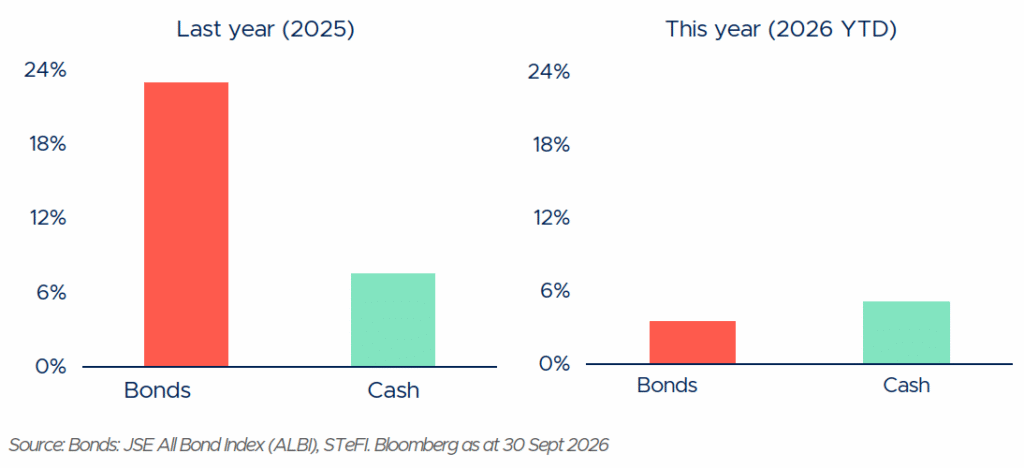
The comparison demonstrates how dramatically fixed-income returns can vary depending on market conditions and the category of risk that one invests in.
Over the long term, fixed income should not be expected to outperform equities, which compensate investors for taking on greater risk. However, fixed income has an important role to play in managing portfolio volatility, generating income and protecting capital. In South Africa, relatively attractive yields provide investors with opportunities to earn meaningful returns without necessarily taking on the risks associated with longer-duration bonds or equities.
The case for income funds
Between traditional cash investments and conventional bond funds lies a category that deserves greater attention: income funds. Within the ASISA classification system, interest-bearing short-term and multi-asset income funds offer investors access to a range of income-generating instruments and strategies.
These funds aim to outperform cash and inflation while maintaining relatively low levels of risk. Capital preservation is a key consideration, making them particularly relevant for investors who want their money to work harder without exposing their portfolios to the full volatility of bond or equity markets.
For advisers, the distinction is important. A traditional bond fund can experience capital losses when yields rise, even if the underlying bonds continue to pay interest. Income funds, depending on their mandate and portfolio construction, take on lower interest-rate exposure and seek opportunities across a broader range of instruments to deliver a smoother return profile.
The Truffle SCI Enhanced Income Fund A, for example, has a track record of delivering 100% positive quarters, while outperforming both SA inflation and its benchmark of 110% of the STeFI cash index. This illustrates the potential value of an income-focused approach that prioritises consistent returns alongside capital protection.
A flexible alternative to fixed-term deposits
Higher interest rates also make bank deposits more attractive. However, investors often need to commit their money for one to five years, or longer, to secure the most competitive rates. Early withdrawals may trigger breakage costs or other penalties, limiting flexibility when circumstances change.
Income funds can offer a compelling alternative. They have historically matched or exceeded deposit rates while providing daily liquidity at the fund level.
For advisers building resilient portfolios, income funds can serve as a core allocation alongside equities over the long term, or as a useful destination for capital during more volatile market periods. With a suggested investment horizon of one to three years, funds such as the Truffle SCI Enhanced Income Fund offer a practical middle ground between cash and traditional bonds. By accepting slightly more risk than cash, investing in a fund that can allocate up to 15% in growth assets, investors have the opportunity to earn higher returns while retaining access to their money and maintaining a strong focus on capital preservation.