


A Stanford study found that investors in North America and Europe tend to focus more on environmental (E) and governance (G) factors in ESG investing, often overlooking the social (S) risks. However, the “S” factors are becoming increasingly important, particularly given the heightened focus on a number of social issues in 2024. The relevance of social factors will differ significantly across different regions and can drive a complex balancing act in aligning to environmental protection. Some of the key developing social aspects are outlined below.
Balancing socio-economic protection with a green transition
South Africa’s unique socio-economic context presents the complex challenge of transitioning to a green economy while addressing local social realities. A Just Transition—one that shifts toward a low-carbon economy while prioritising social well-being through decent employment opportunities and inclusive community engagement—is essential for sustainable transformation. This approach recognises that environmental progress must go hand-in-hand with social equity. South Africa joins 65 other countries that have explicitly incorporated Just Transition principles into their Nationally Determined Contributions (NDCs), the frameworks that outline each nation’s emissions reduction commitments.
We are increasingly seeing countries attempt to balance environmental ambitions with economic realities. For instance, Indonesia had initially planned to phase out coal-fired plants by 2040. However, in light of pressing energy security concerns, the country is now constructing new coal plants and extending the lifespan of existing ones. While environmental risks remain high, the socio-economic challenges of transitioning to greener energy are likely to materially shape the pace and path of the energy transition- particularly for higher risk sectors such as coal and mining.
Minimum wage pressures
Inflationary pressures in 2024, drove significant minimum wage increases across multiple countries. Argentina implemented a substantial 51% increase while Japan recorded its highest-ever increase of 5%, Nigeria more than doubled its minimum wage, and Saudi Arabia raised wages by 45%. South Africa’s 4.4% increase, though aligned with inflation, represented the highest rise since the introduction of a minimum wage. South Africa also amended its Company’s Act to require disclosure of the ratio between highest and lowest earners within companies.
Minimum wage movements reflect efforts to preserve living standards for low-wage workers and advance social justice. Ongoing inflationary and cost-of-living pressures, will likely sustain upward pressure on minimum wages, creating particular risks for sectors with high exposure to minimum wage labour such as Retail.
Social regulations
The EU introduced supply chain regulations in 2024 through the Corporate Sustainability Due Dilligence Directive, targeting social and environmental risks across companies’ supply chains. This directive requires due diligence across the entire value chain extending beyond direct suppliers. Although the regulation applies to a limited number of companies based on specific criteria, it signals a broader trend of increasing scrutiny of environmental and social risks throughout supply chains. The directives will particularly impact companies operating in the EU and those that do business with EU-based organisations.
Increased social disclosure
The formation of globally recognised Task Force on Inequality and Social-related Financial Disclosures (TISFD) in 2024 marked an important development in social risk reporting, though still in its early stages. TISFD aims to provide comprehensive guidance on social risks mirroring the frameworks established by TNFD for biodiversity risks and TCFD for climate-related risks.
Managing social factors in practice
Social issues receive greater attention in South Africa where the unemployment rate is high. Truffle’s ESG approach considers specific social factors or issues that have a material impact on valuations and earnings as well as our engagement approach with company management. These can broadly be grouped into systemic issues which are inherent in a company or industry given the environment and business operating model, and incident-specific issues.
By way of example, Truffle identified labour exploitation as a systemic issue across certain companies and industries. Our research approach included an evaluation of human rights risks in supply chains, focusing on industries such as Mining, Fashion, Luxury Goods, and Agricultural products (including tobacco).
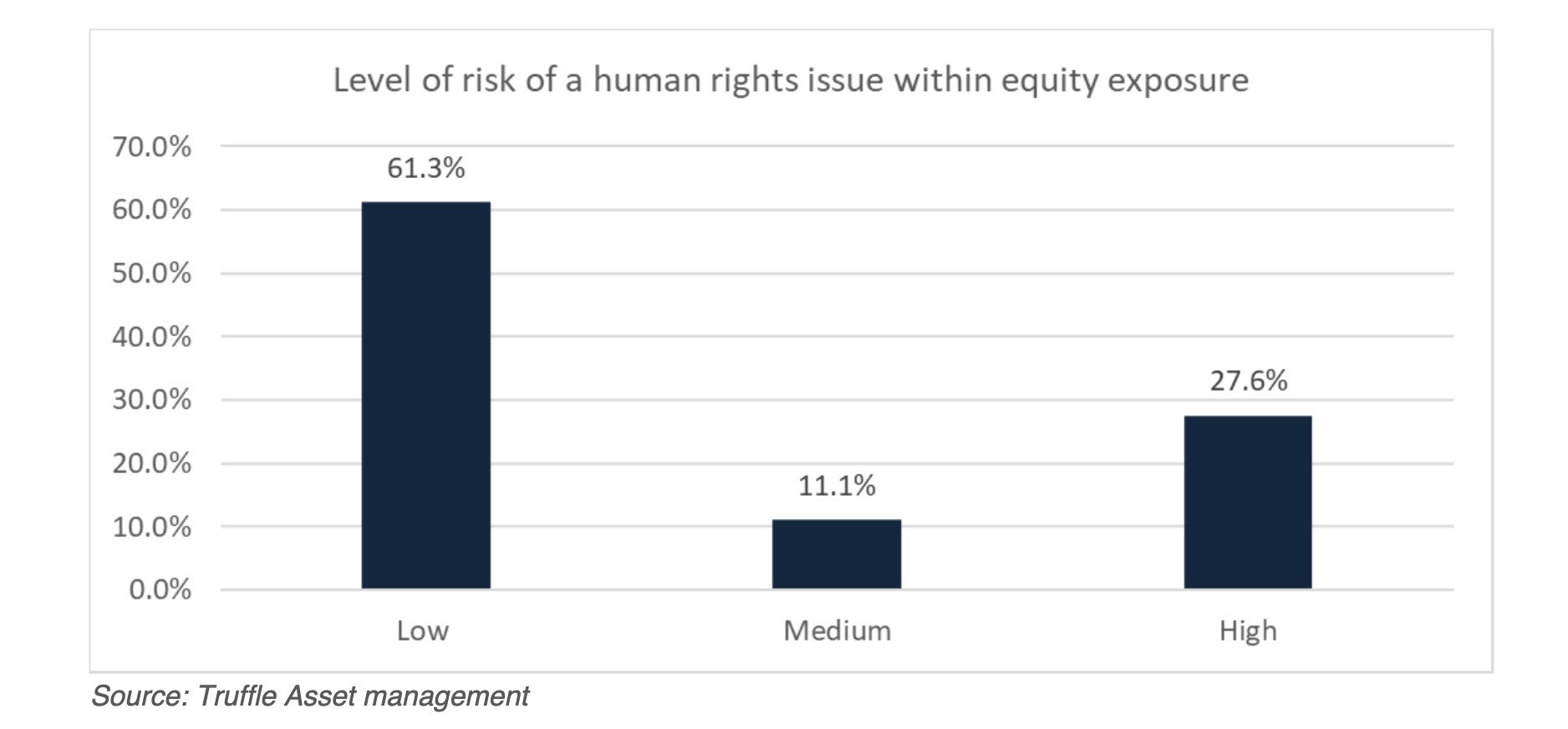
Our evaluation included a review of each company’s human rights policy and considered any controversies around human rights abuses in the past three years. The results of the analysis as it relates to companies held in the Truffle SA Equity mandates indicate that 96% of companies have human rights policies in place, while the chart below shows the level of risk within the equity exposure. These findings informed ongoing engagements with high-risk companies.
Delving into a specific incident
In April 2024, a key incident highlighted human rights risks and prompted engagement with SA apparel retailers. Some of Giorgio Armani’s operations had recently been placed under judicial administration for exploiting migrant workers in their Italian supply chain. We engaged with companies in the fashion and luxury sector to assess their exposure and supply chain management around human rights abuses. We established that SA companies engaged have specific Child and Forced Labour policies in place with only one showing a minor related controversy related.
In follow-up discussions with company management, we also gained comfort that these local fashion companies are undertaking consistent monitoring with regular audits across the supply chain.
In conclusion
The ESG landscape continues to change and evolve. More recently, macro-economic and geopolitical pressures have brought Social factors to the fore with the added challenge of balancing effective social and environmental outcomes. Truffle is committed to ESG integration in our investment process and our approach ensures consistent monitoring and response to industry-wide and company-specific Social risks.
